Showing posts with label Insects. Show all posts

Wednesday, July 26, 2017

Bigelow Cemetery State Nature Preserve, Madison County, Ohio


After I wrote the blog about the Royal Catchflies in our yard and our experiences with them, Tom and I decided it was time to make the excusion to see Bigelow Cemetery State Nature Preserve, the place where we first saw Royal Catchflies.

The first time I saw the cemetery was with a group of volunteers from Brukner in the early nineteen eighties.  This sign had not been erected.  Naturalists in Ohio had only recently become interested in the prairies that appear here and there in Ohio.


Tom and I have been here many times over the years. The first times he and I both walked the paths. Now Tom waits in the van while I explore.  He brought a book along to read while I walked for forty minutes.


The trees in the distance are Burr Oaks, the tree associated with Ohio prairies.  Its tough thick bark can withstand prairie fires.


This monument marks the burial spot of Stephen Smith, age 11, who died in 1833. The earliest tombstones date to 1814 and the last known burial was in 1892.


                                          Prairie Dock


This is the gravestone of Dr. William King.  He "Died April the 14th 1844  Aged 30 years 11months and 5 days".  Many of these stones have the exact day of the person's death described like this.  It makes me feel that people appreciated every day that they lived.  Below, mostly hidden by the flowers is a message:
"My glass has run, my grave you see
In time prepare to follow me.
Go home dear friends and dry your tears,
I must lie here til Christ appears.
And when he does, i hope to rise
Unto a life that never dies."

                                        Sainfoin (Scurf-Pea)

Mostly Gray-headed Coneflower, two Purple Coneflowers, and two Royal Catchflies.  Burr Oaks in the background.

                     Honeybee on Wild Bergamot

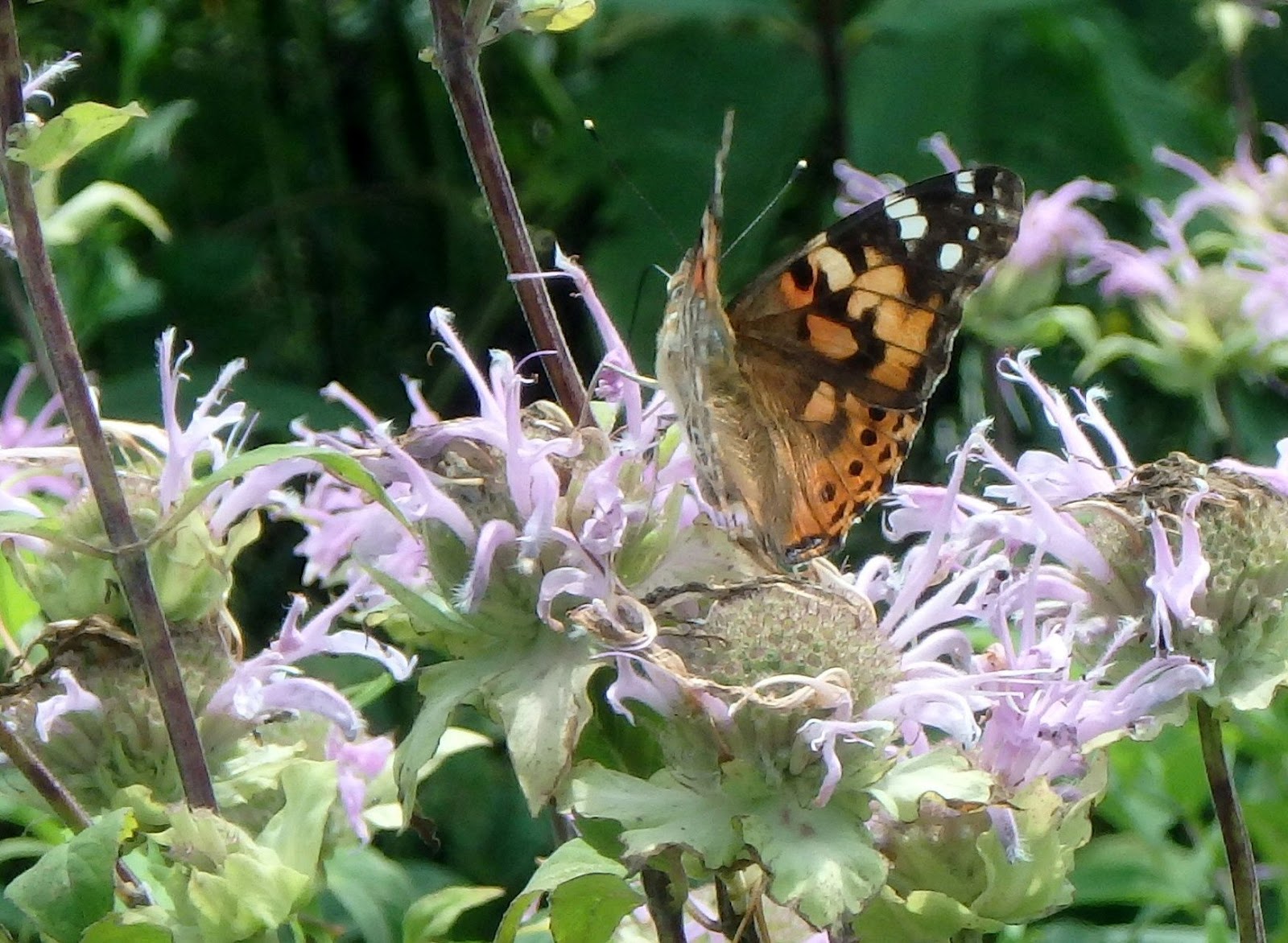
                               Painted Lady

Leaves and developing acorns of the Burr Oak

Various prairie flowers.

In this photo, you can get a good look at the calyx beneath the red petals.  The calyx is sticky which is why the plant is called a "catchfly".

I saw a Ruby-throated hummingbird at least a half dozen times nectaring at the Royal Catchflies but I wasn't as fast with my camera as the hummingbird was with his wings.  I'll just have to keep him in my memory.

Thursday, April 27, 2017

A Walk with John and Tom at Garbry Big Woods Sanctuary, Monday, April 24, 2017


The sanctuary floor was dominated by the Large-Flowered Trillium and the Wild Blue Phlox.


Leaves are opening on the trees.


Among the Large-flowered Trillium, there are a smaller number of Drooping Trillium.  Sometimes this is called Bent Trillium.


And sometimes Drooping Trillium is maroon.


An even more unusual Trillium is this one...a double trillium.  I wonder if it is a mutant. It is pink because it is aging.


The Wild Hyacinths are becoming showy.  They will be at their peak by this weekend.


The Wild Ginger is blooming.


And after much searching we found a Mayapple blossom.


We found some creatures, too.


Bee Flies were hovering at flowers, and most were zipping off before a person could get a camera focused on them.  Tom "caught" this one.


Tiger Beetles were sunning on the boardwalk, then flying further ahead when we came too close.


We saw Silver-spotted Skippers.  The "Silver" spot is on the underside.


We saw daytime flying moths as well as butterflies.  This one is a Four-spotted Angle.  I learned this from the Ohio Moth site that I follow.


Tom and I were pleased he got this photo of a Five-lined Skink.  We have seen them the last two times we have walked here.  A skink is a reptile, a cousin of lizards.

And we did see one more reptile, a Garter Snake.  They are common in Garbry Big Woods Sanctuary.  They are a shy snake and slither away quickly.


I never get tired of walking in this woods.  There is always something different from the last time I visited.


Thursday, March 30, 2017

Butterfly Transect at Brukner Nature Center...Some Results from the 2016 Season

The 2017 Ohio Butterfly Transect Monitoring begins, weather permitting, on April first.  I have been seeing butterflies on warm days so I know they are on the move.

Last year we saw a greater number of species than we saw in previous years.  I like to think it is because our eyes are sharper now that they are practiced at finding butterflies.


We saw 38 species in 2016. The species we saw most often was the Silver-spotted Skipper.  2016 was a bumper year for Silver-spotted Skippers.  Officially, we saw 424 which was 44% of all butterflies we saw.  By comparison, in 2015 we saw only 54 which was 9% of all the butterflies we saw.

Silver-spotted Skipper (Epargyreus clarus)

The Cabbage White was the second most often seen.  Most years, it is the most common seen.  A non-native, it thrives in our area.

Cabbage White (Pieris rapae)

Coming in third in numbers seen in 2016 were the Pearl Crescents. They are one of our common butterflies though not always in the top three.

Pearl Crescent (Phyciodes tharos)

In 2016, we didn't see any butterflies that have never been sighted in Miami County but we saw eight that we had never seen before on the Brukner Nature Center Butterfly Transect.

Harvester (Feniseca tarquinius)

Common Buckeye (Junonia coenia)

Pipevine Swallowtail (Battus philenor)

Common Checkered-Skipper (Pyrgus communis)
.
Gray Hairstreak (Strymon melinus)

The others, for which I don't have labeled photos were Zebra Swallowtail, Common Sootywing and Tawny-edged Skipper.

If the temperature is warm enough, the minimum being 60 degrees and almost full sun, we will start the 2017 season this weekend.

I hope you are seeing butterflies wherever you are.

Saturday, September 10, 2016

Silver-spotted Skippers Everywhere...Brukner Nature Center Butterfly Transit, August 28, 2016


Silver-spotted Skipper (Epargyreus clarus) Wingspan 1.75-2.40 inches (4.4-6.1 cm)

This is one of the over 83 individual Silver-spotted Skippers that Ruth, Joanie, Molly, and I saw on the walk on August 28. None of us have ever seen so many on one walk.  (The following weekend, September 3,  the group counted at least 110.)  To me, this seems to prove the saying, "No matter what kind of weather a year brings, it is perfect for some creature or plant."

Thanks to Molly, I can now identify a Pipevine Swallowtail.  Identifying the mostly black butterflies has always been a problem for me.  I am still in the process of memorizing the various distinguishing markings.  The blue on the body I will remember.

 Pipevine Swallowtail (Battus philenor)  Wingspan 2.75-4.00 inches (7.0-10.2 cm)

The day was hot, 90 degrees Fahrenheit, (32.2222 C)  The day was humid as well. Sweat ran down my face and into my eyes.  But the butterflies made the day perfect. Our count for the day follows:

Clouded sulphur...5
Cabbage white...9
Silver-spotted skipper...83+
Pearl Crescent...19
Pipevine swallowtail...1
Eastern Tailed Blue...11
Summer Azure...6


Eastern Tailed-Blue (Everes comyntas) Wingspan 0.75-1.00 inches (1.9-2.5 cm)

Pearl Crescent (Phyciodes tharos) Wingspan 1.25-1.60 inches (3.2-4.1 cm)

I just now looked again at the Pearl Crescent information in Butterflies of Indiana, A Field Guide by Jeffrey E. Belth.  He points out that there is a crescent on the underside of the hind wing of Pearl Crescents.  And I see one in this photo.  Something else new I've learned.

Friday, September 12, 2014

Brukner Nature Center, Butterfly Transit, August 30

Jim and Ruth, Stephen and I walked the transit on August 30.  It was a good day to see butterflies.  We saw thirteen species, thirty-four specimen.

I think the Black swallowtail may have been the first one Stephen has ever seen.  They are not as common as some of the other swallowtails.

Black Swallowtail (Papilio polyxenes) Wingspan: 2.5-4.2 inches (6.4-10.7 cm)  It is sitting on a Field Thistle.

We saw nine Eastern Tailed-Blue (Everes comyntas).  It was especially interesting to see this mating pair.  It is good to know Eastern Tailed-Blues will be around next year.

Eastern Tailed-Blues (Everes comyntas) Wingspan: 0.75-1.00 inches (1.9-2.5 cm)

The other butterflies we saw included five Hackberry Emperors, one Question Mark, Thirteen Cabbage Whites, 2 Summer Azures, one Painted Lady, one Pearl Crescent, and one Silver-Spotted Skipper.

Thanks, Jim, for the photographs.

Thursday, July 31, 2014

Brukner Nature Center, Butterfly Transit, July 26, 2014

Thank you, Phil, for sending the following photos.  I didn't come for the transit walk because I was watching a grandson and his dog compete at the Ohio State Fair in Columbus.

Common Wood Nymph (Cercyonis pegala)--Wingspan 1.8-2.8 inches (4.6-7.1 cm)


I like this photo because it shows the delicate vein pattern in the wings.

Summer Azure (Celastrina neglecta) Wingspan: 0.80-1.25 inches (2.0-3.2 cm)

There can be two or more broods of Summer Azures during the summer.

Painted Lady (Vanessa cardui) Wingspan: 1.75-2.40 inches (4.4-6.1 cm)

Many butterflies, like this one and the Common Wood Nymph, nectar at Purple Coneflowers.

Giant Swallowtail (Papilio cresphontes)  Wingspan: 4.5-5.5 inches (11.4-14.0 cm)

I am really sorry I didn't get to see this butterfly.  It is one of the largest butterflies in North America.  It is in Ohio but not common.  I haven't seen one this year.

Phil took a photo of the upper side of the wings, and also took two nice photos of the underside.  The first time I saw a Giant Swallowtail I was really surprised to see how different its underside is from the upper side.