Showing posts with label Rocks. Show all posts

Thursday, March 21, 2013

Earth Colors by Sarah Andrews, a Book Review


I read a lot of mysteries.  Sometimes, in the winter when the weather is bad, I will read as many as eight in a month.  Usually I get the books from the local library and that is where I found Earth Colors by Sarah Andrews.  I liked this book so much that I bought two copies, one for myself and one for my daughter who has a masters in geology.The mystery revolves around a Remington painting.  Is the painting authentic or a copy?   The sleuth is Em Hansen, a geologist looking for a subject for her master's thesis.

What, I , as a mystery reader, really want is a good entanglement where right triumphs over wrong in a few hundred pages.  Mysteries are an escape for me from the entanglements of real life where motives and solutions only evolve over years of a person's lifetime.  And Sarah Andrews provides this escape, along with interesting and believable characters, some of whom appear over and over in the series.

What makes this book different from most  mysteries is not only the amount of information Sarah Andrews incorporates about geology in general but also the history of pigments and their relationship to the geology of  Pennsylvania which she explores as the mystery progresses. Being an artist, I found that history  interesting as well as the information about analyzing those pigments which Em Hansen learns.

Sarah Andrew's thoughts on environmental issues are always interesting to me, too, and come up in other books of this series.  One of her characters in this book, Jenny, said something that impressed me so much I added it to my little book of inspiration to live by.

Jenny and Em, the geologist, are discussing how Jenny is able to maintain a happy attitude when she loses battles to preserve significant features of the landscape.  Jenny tells Em about the chestnut tree blight  that  destroyed all the chestnut trees in the eastern United States many years ago. There are still very old stumps sending up new sprouts.  The sprouts die when they reach a flowering age because the blight kills them.  These are wonderful trees, extremely rot resistant.  A person can still find barns and homes built with chestnut lumber.  Scientists have been working for years to find a way to counteract the blight.

Jenny tells Em,  "Nothing lasts forever in this world, not even blight.  So I think I'll just honor my roots and keep on sending up my sprouts."

Tuesday, November 13, 2012

Miami County Education Staff on the Job

October sixth was a beautiful day. After we voted, Tom drove to Charleston Falls.  He said he'd sit in the van and read while I hiked. 

When we arrived, we saw a group in one corner of the parking lot. They were the park education staff reviewing how the day had gone.


I didn't want to interrupt them so I took two quick photos and then started off on my hike down past the falls.

A jumble of erratics, rocks left behind by the glaciers, is not far down the trail. There I came across this heap of teaching materials. I recognized the station because I have videotaped students busy there in the past. There are hammers and goggles in the crate and boards behind it. This is where the students talk about the glaciers and then break open small geodes.


Now I knew the topic for the day, Rocks.
 

Further along the trail, I saw education staff members picking up the materials from another station.


Before they moved on to continue their pick-up detail, I snapped their picture.

They went on about their business and I continued toward the Thorny Badlands Lookout Tower. On the way, I came across another station waiting for pick up. This is where the students examine closely the composition of soil.


"How lucky these sixth grade students were today," I thought as I walked on. "They were officially "learning" and at the same time outside on a beautiful day, not in a stuffy classroom."

Thursday, July 12, 2012

Tom's Prairie Bed

On July 2, the day after our second power outage and before our power was restored, I took this photo of Tom's flowerbed. The Prairie plants were unfazed by the wind and rain.

Below is the same bed. I took this photo taken a few minutes ago. The plants are still looking decent although the outer edges of the purple coneflowers (Echinacea purpurea)  are drying and turning brown. That is probably as much due to the dryness as to the aging of the blooms.   But they have weathered the dryness as well as the windy storms. 


Beyond the Black-eyed Susans (Rubeckia) the grass in the yard is brown. It doesn't have the deep roots the prairie plants have.


Even the Blazing Star (Liatris) that I transplanted to the bed this spring are looking good. They are the only prairie plants that I transplanted this spring that are blooming. I am sure that the buckets of water that Tom has been pouring on them on alternate days have made the difference.

Tuesday, June 5, 2012

Hug the Earth Festival, 2012, Songs and Activities, Part 2

 
Here is Marine Mark leading children in dance to the tune of "I'm a Tree". "I'm a tree, I'm a tree, and I'm growing very tall".


Doug the Drop leads the Water Cycle Boogie Dancers. "The watercycle boogie goes round and round. The watercycle boogie goes up and down".


The Everything Needs a Home singers..."Everything needs a home, a habitat, a place to roam".


Airy Larry, The Plant Man, leading the Roots, Stems, Leaves, Flowers, Fruits, and Seeds singers. "Roots, Stems, Leaves, Flowers, Fruits, and Seeds, Six plant parts that every plant and animal needs".

There were lots of other activities besides the big concert.


Mike Manning, The Rock Man, showed these children fascinating rocks and talked about how people used them.


The children panned for treasure and found some of the rocks Mike talked about. Here is what one child found.


On the other side of the park, workers from Ohio mining put on a skit which emphasized that everything is mined or grown.


One child was dressed up as a miner.


These children mined for Ohio ores in especially prepared sand hills.


Then they took their pail of rocks to a table where they could compare what they found with named samples.


All of the children played with , a huge inflated "Earth" ball, and all ate a picnic lunch with their classmates.


  On Friday, the younger students were treated to a visit from the Kentucky Reptile Zoo. They saw a variety of reptiles.


The older students had a special treat, a Ropes Campus where they could climb a "Cliff", walk high above the ground on ropes and zip down a Zip Line. Tom pulled this photo from a video.


Here are students climbing the rock wall.
.

Tuesday, February 28, 2012

Winter Aconite...Eranthis Hyemalis


I took this on February 21. Eleanor's Winter Aconite has been blooming since early in the month. There were  below freezing days and also  snow after it began blooming. You can see by this photo that the plants were not stopped by a little cold and snowy weather. This is one of those flowers that closes on dull days and opens on sunny days. Tom took the rest of the pictures on February 22 with his Canon, a much more sophisticated camera than my little Fuji Z300.
.

Here is how her flowers look from the road.


And here is how they look up close. You can see that the flowers are beginning to fade. The petals are completely bright yellow when they are fresh. Winter Aconite is garden flower which naturalizes easily if the conditions are right. It likes early morning sun. It is native to southern Europe and east across Asia to Japan.  Its name comes from the Greek  "akone" meaning "whetstone", probably because it grows in stony areas.

Tuesday, February 7, 2012

Winter Shadows, Part 4


This is the painting as it looked in Part3.


These are the places where I intended to make changes.


Here it is after the changes were made.  I also made a few additional changes.  I lightened the background trees and gave them more of an angle so they would "point" to the cliff and to the trail.  I also extended the distant edge of the cliff to simplify that area and to make the steepness of the trail more apparent.

The painting is finished except for some minor tweaking, a paint stroke here and there.  I will sit it on my easel and look at it now and then as I work on other projects. 

It is important to choose a subject that you really want to paint.  Otherwise you will be tired of the whole thing before you are finished.  This subject has passed the test for me.  I am thinking of doing a larger painting of the same subject.  I am also considering doing an abstract version, even although I rarely do abstracts.

If you have trouble leaving a comment, click on About Leaving a Comment under Labels to the right of this blog.  This is a way that some people have found will work for them.


Tuesday, January 31, 2012

Winter Shadows, Part 3


This is the painting after the mask has been removed from the near rocks.


Here I have softened the areas of the rock cliff  which I had masked.  I used a stiffer brush than I normally work with.  This requires careful strokes, firm enough to smudge the sharp edges but light enough so  I don't damage the paper.  A few light glazes of cobalt blue also softened the masked areas. 

I darkened the trees with cobalt blue  and added Orange Lake to the largest tree as well.  I want that tree to be the most prominent. 


A wash of Antwerp blue brightened the sky and distant snow.  I continued working on the near cliff wall to give it more rocky texture and shape.


I am getting close to being finished so I printed the painting in grays.  This helped me focus in on the areas that I will concentrate on next.

If you have trouble leaving a comment, the directions for one way to do so are in "About making a comment" under Labels to the right of this blog.


Tuesday, January 3, 2012

Winter Shadows..First Steps


As the painting looked last week.

Stage 2
I started putting texture on the trees with Orange Lake and added another wash of Cobalt Blue to the background.

Stage 3 with Maskit protecting whites
I protected the white of the paper with Maskit which is a bit like rubber cement but  better chemically for the paper.  I laid a wash of Primary Blue over the sky, Burnt Sienna and Orange Lake for the distant trees and a wash of Ultramarine Blue to darken snow in the valley.  The blue on the nearer trees  is Cobalt.

Stage 3 with no Maskit on right side
I took the mask off so I could see the contrasts on the trees.

Stage 4
I added texture to the distant trees with scribbles,  a mix of Burnt Sienna, Cobalt Blue, and Orange Lake. I worked a little on the far cliffs. and so on. I decided the most prominent tree needed reshaping.  I added short strokes of Orange Lake and Cobalt Blue.  I  added washes of Quinacridone Gold, Orange Lake, and Cobalt Blue on the near cliffs. I removed the Maskit and add more washes of Quinacridone Gold, Orange Lake and Cobalt Blue.  The last thing I did was put splotches of Maskit on the cliffs to preserve some of the new washes.  Next I will add more washes to the cliffs and see what I then have.

Tuesday, December 27, 2011

Playing with Glazing Techniques.


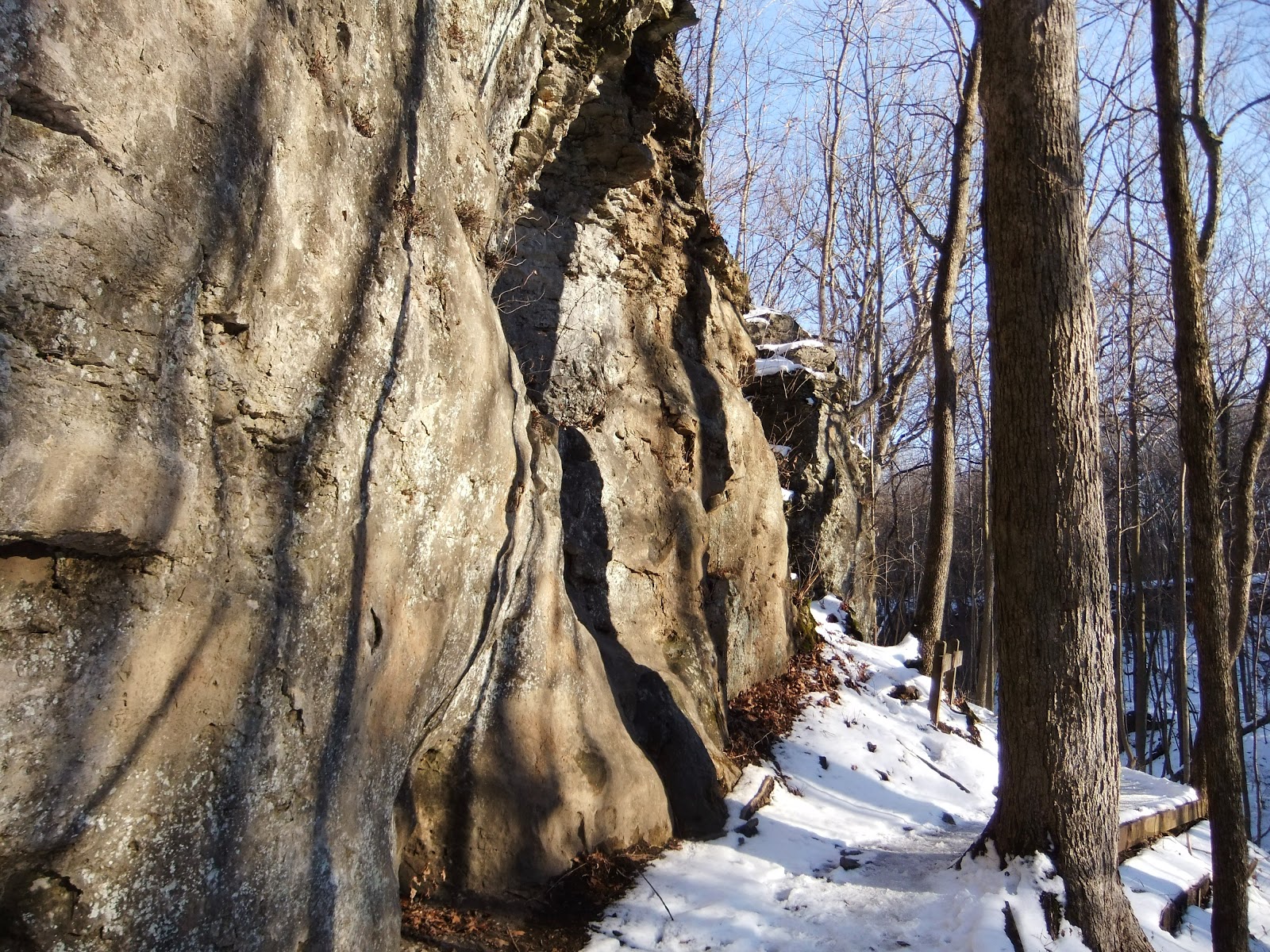
I took this photo at Charleston Falls in 2010.  I was hiking in the afternoon and the sun was bright.  Everywhere the shadows were interesting.


Yesterday I decided to use this as a reference photo for an 10 inch by 8 inch painting.  I did enough of a sketch to position the various components and then began laying down pale washes of color using a Stephen Quiller No. 12 brush made by Richeson.  Naming the manufacturer of the brush is important because all No. 12 brushes are not the same size.  The No. 12 brush is the largest brush in the photo below. Its full body holds a lot of water and color.

With it are some of the other brushes I use.  I rarely use the smallest bodied one, a No. 2 Escoda.  Instead, I use the No. 4 Escoda for most of the detail work.  That is the second brush in the line-up.


Thursday, December 1, 2011

November 15, 16, and 30

Up until November 15, we had weather that wasn't much different from the latter part of October.  The morning temperatures might be in the thirties in the morning but by afternoon, the temperatures would be in the fifties and sixties.  This is a time of year when I am glad we are in southern Ohio rather than northern Ohio where the temperatures would be five to ten degrees cooler.

But even though the temperature was in the fifties and there was no breeze so walking at Charleston Falls on November 15 was pleasant, I knew I was walking on a November day.

This photo was taken about three in the afternoon.  To get the exact sky, the camera shows the grass as much duller than it actually was.

The bright green of the trail and the ominous sky mean November to me.  I wasn't especially pleased to see the sprinkle of red along the tree line.  The red comes from bush honeysuckle, an invasive species which holds its leaves long after the native plants are gone.  The birds eat the berries and spread the plant everywhere.


But I did enjoy listening to the falls.  All three were flowing, the two that always flow and the intermittent falls which flows only when we have had unusual amounts of rain.

We'd  had so much rain that the Great Miami River was spreading over its floodplain again.


I walked the following day, too.  It was a bright and sunny day.  There was a lovely sky.  The park staff was leading a group of children on a tour of the special rocks of our part of Ohio and teaching the importance of all rocks.  The children had never thought of aluminum cans as coming from rock or of rocks being important in the manufacture of their techie toys like cell phones and computers.  And of course, they talked about salt as being a rock.  As they hiked back to the buses in the parking lot, they stopped at a jumbled group of erratics brought by the glaciers of long ago.  Each child climbed on one and jumped off, shouting, "Thank you, rocks."


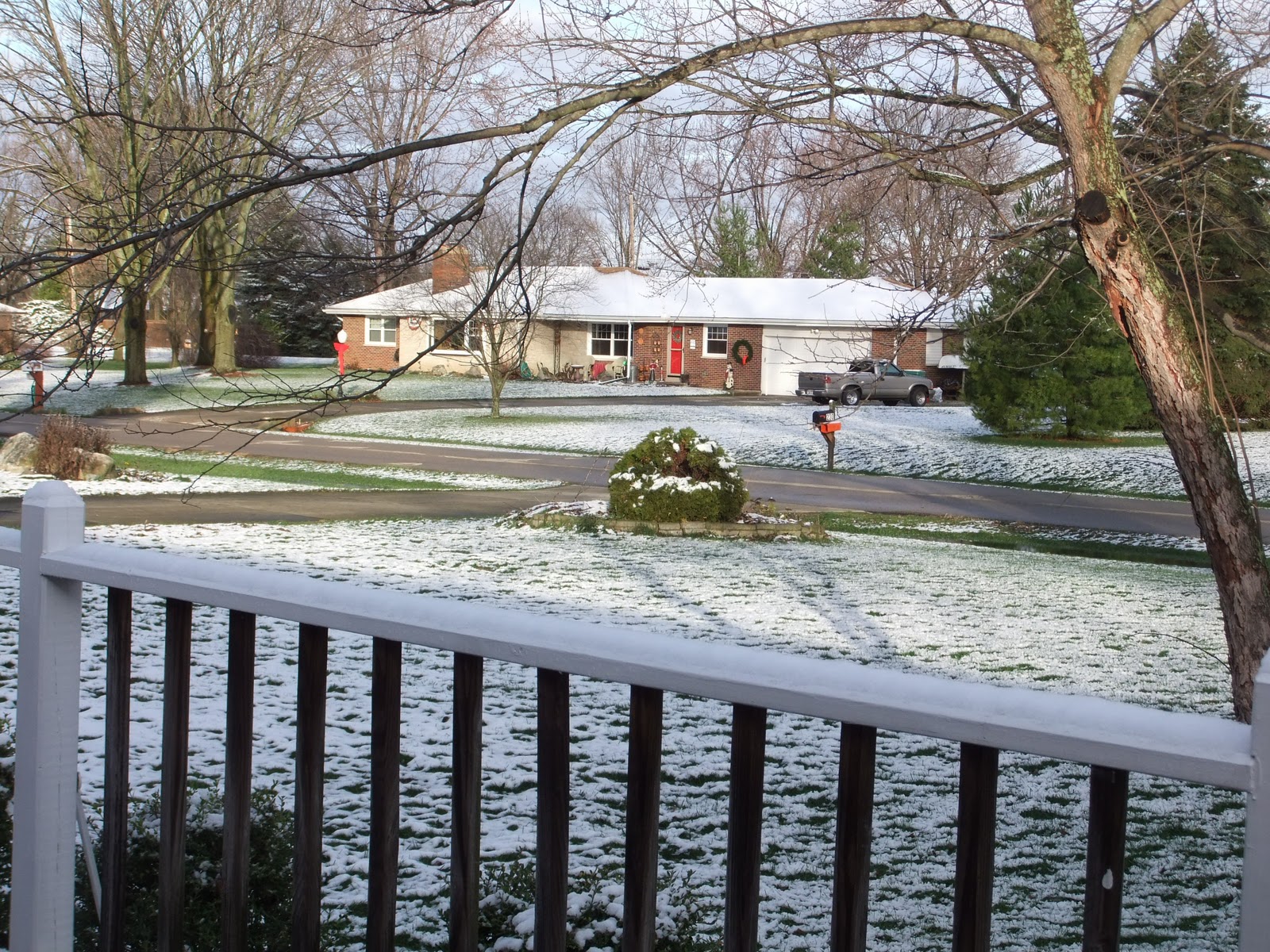
Officially, for me, winter arrived on November 30.  We had our first significant snow.


But, by afternoon, it had melted away.