Showing posts with label Jim Bowell's Photos. Show all posts

Thursday, March 30, 2017

Butterfly Transect at Brukner Nature Center...Some Results from the 2016 Season

The 2017 Ohio Butterfly Transect Monitoring begins, weather permitting, on April first.  I have been seeing butterflies on warm days so I know they are on the move.

Last year we saw a greater number of species than we saw in previous years.  I like to think it is because our eyes are sharper now that they are practiced at finding butterflies.


We saw 38 species in 2016. The species we saw most often was the Silver-spotted Skipper.  2016 was a bumper year for Silver-spotted Skippers.  Officially, we saw 424 which was 44% of all butterflies we saw.  By comparison, in 2015 we saw only 54 which was 9% of all the butterflies we saw.

Silver-spotted Skipper (Epargyreus clarus)

The Cabbage White was the second most often seen.  Most years, it is the most common seen.  A non-native, it thrives in our area.

Cabbage White (Pieris rapae)

Coming in third in numbers seen in 2016 were the Pearl Crescents. They are one of our common butterflies though not always in the top three.

Pearl Crescent (Phyciodes tharos)

In 2016, we didn't see any butterflies that have never been sighted in Miami County but we saw eight that we had never seen before on the Brukner Nature Center Butterfly Transect.

Harvester (Feniseca tarquinius)

Common Buckeye (Junonia coenia)

Pipevine Swallowtail (Battus philenor)

Common Checkered-Skipper (Pyrgus communis)
.
Gray Hairstreak (Strymon melinus)

The others, for which I don't have labeled photos were Zebra Swallowtail, Common Sootywing and Tawny-edged Skipper.

If the temperature is warm enough, the minimum being 60 degrees and almost full sun, we will start the 2017 season this weekend.

I hope you are seeing butterflies wherever you are.

Friday, July 1, 2016

Brukner Nature Center...Butterfly Transit Update, July 1, 2016

I have been lax in putting up Brukner Nature Center Butterfly Transit blogs for a number of reasons...partly due to rainy days and partly due to other activities that have come up.

The group is still plugging away.

We have had a couple nice finds...the first Least Skipper that has been recorded at Brukner (June 19), probably because no one has been looking for them and on June 24, a Banded Hairstreak.  We have seen Banded Hairstreaks other years but we don't see them often.

Least Skipper
Banded Hairstreak

Butterfly weed was found blooming on June 19...


and on June 24, Phil photographed this Great Spangled Fritillary on  a butterfly weed.


We have been finding caterpillars...

found on willow on June24.  No ID

This one was found on June 19.  I didn't go on that walk so I don't know what it is.

I learned a couple things, one thanks to the Ohio Butterfly site and the other thanks to the Ohio Wildflowers and Fauna site.

This is a moth I saw on June 24.  It is either a Virginia Ctenucha ( Ctenucha virginica) or a Yellow-collared scape moth (Cisseps fulvicollis).  To know positvely, I needed to get a photo of the thorax.  Maybe I'll see another one.


This is Enchanter's Nightshade.  It is widespread throughout the Brukner wet woods.  The plants with the tiny white flowers have always overwhelmed me.  There are lots of them this time of year and I never knew where to start looking in the field guides.  All the tiny flowers were too tiny for me to distinguish.

Saturday, May 14, 2016

Brukner Nature Center Butterfly Transit Walks for May 1 and May 12, 2016

May 1

The Brukner Nature Center's front entrance is in the process of being updated.  All the plants we found butterflies on last year have been torn out.  The good news is that more will be put in.  Now, however, the lack of plants mean that we aren't seeing butterflies in an area where we usually find quite a few.

 Our best sections for finding butterflies on May 1st turned out to be on the sections just beyond the meadow on the Hickory Ridge trail.  There we saw seven Red Admirals.

Red Admiral (Vanessa atalanta)  Wingspan 1.75-2.50 inches (4.4-6.4 cm)

We also saw four Eastern Commas in the same area.

Two Eastern Commas ( Polygonia comma)  Wingspan 2.0-2.4 inches (5.1-6.1 cm)

Jim found this American Painted Lady (Vanessa virginiensis).  They are similar to a Painted Lady (Vanessa cardui). Seeing the underside makes the identification easier.

American Painted Lady (Vanessa virginiensis) Wingspan 1.75-2.40 inches (4.4-6.1 cm)

The Henry's Elfins (2) were found flitting around the redbud blossoms just as they were on
April 24.  This photo is from April 24.

Henry' Elfin (Callophrys henrici) Wingspan  0.9-1.2 inches (2.3-3.0 cm)

Other butterflies that we saw were Cabbage Whites (4) and a Pearl Crescent.

May 12
The transit group attempted to monitor the trail on May 7 (Saturday) but it was not a good day for seeing butterflies...spitting rain, wind gusts, temperatures below 70 degrees Fahrenheit.  The group gave up on counting butterflies.  Nancy and Phil went out on Thursday, May 12,  which was a nicer day.  They found butterflies but they were elusive so Phil didn't get photos of them.  They counted a Red Admiral, a Silver-spotted Skipper, a Pearl Crescent, 5 Cabbage Whites.  In addition, two orange butterflies flitted by so fast, neither Nancy nor Phil got a good look at them.

However Phil did get these photos of turtles who live in Cattail Pond.

Painted Turtles (Above)


I'm not sure which turtle this is.  I know Snapping Turtles live in the pond but there may be other species, too.  I'm not sure the back is lumpy enough to be a Snapper.

I am reporting this on May 14.  Neither today nor tomorrow will be a good day for counting butterflies.  Today the high is predicted to be about 50 degrees Fahrenheit and there is a frost warning tonight.  Weather forecasters are suggesting that delicate plants should be covered.

We have had a few nice spring days but many more days when May has felt like March.  All of us are hoping for a few weeks of spring before the hot days of summer show up.


Saturday, January 9, 2016

The Quest of a Lifetime, the Search for the Monarch Butterflies Wintering Grounds


I was pleased to see Google's Doodle this morning.  I checked out some of the sources provided by Google.  Ken Brugger and his wife Catalina Aquado discovered the wintering grounds of the Monarchs high in Mexico's Sierra Madre Mountains in 1975.  They were among the first "citizen scientists" recruited by Fred Urquhart, a Canadian scientist.  Urquhart started research on the route and destination of the Monarchs in 1937.  The search lasted thirty-eight years.


There is a group from Brukner Nature Center planning to visit the wintering grounds in February.

Tom and I won't be with them but we did see the wintering grounds of the Monarchs on the west side of the Rocky Mountains.  They winter along the California coast.  We saw them in a Santa Cruz  park and also in Natural Bridges State Park.  It was surprising to me how much they blended into their surroundings...until they moved.  Seeing the butterflies set forth in the morning from the trees in the Santa Cruz park was like watching flowers flying off the trees.


Saturday, September 5, 2015

Butterfly Transit at Brukner Nature Center, August 29, 2015

The day was hot.  There was a threat of a pop-up thunderstorm.  The mosquitoes were plentiful although there were fewer than a few weeks ago.

The Monarchs are showing up.  We counted four.

Monarch (Danaus plexippus)  Wingspan: 3.5-4.0 inches (8.9-10.2 cm)

We were excited to see an American Snout butterfly.  This is only the second one we have seen in our three years of walking the transit.

American Snout (Libytheana carinenta)  Wingspan: 1.6-1.9 inches (4.1-4.8 cm)

This is another photo of the same butterfly.  I like the picture because Jim also caught a Ailanthus Webworm Moth in the same picture.  The Ailanthus larvae make communal webs on the leaves of  Ailanthus Trees.  Isn't the moth pretty?

American Snout with Ailanthus Moth (Atteva punctella)

We found four Silver-spotted Skippers.  This one was posed exactly right to get a frontal pose.

Silver-spotted Skipper (Epargyreus clarus)

Ruth identified this Wild Indigo Duskywing.  Duskywings are a group of dark butterflies. It is hard to tell one from another.

Wild Indigo Duskywing (Erynnis baptisiae)  Wingspan: (1.3-1.7 inches (3.3-4.3 cm)

We saw a Painted Lady on Wingstem..  I think this is the first Painted Lady we have seen this summer.  Last year we saw numerous Painted Ladies so we should be seeing more on future walks.

On the same plant was a Monarch.  If you look closely, you will see there are also two bees on the plant.


Upper butterfly: Monarch (Danaus plexippus) Wingspan: 3.5-4.0 inches (8.9-10.2 cm)
Lower butterly: Painted Lady (Vanessa cardui) Wingspan: 1.75-2.40 inches (4.4-6.1 cm)
Plant: Wingstem (Verbesina alternifolia)

The most exciting find of the day was a Viceroy Butterfly along the drive.  This was a first sighting ever on the transit.

Viceroy (Limenitis archippus)  Wingspan: 2.6-3.2 inches (6.6-8.1 cm)

Viceroy

Here is a Monarch photo taken by Tom earlier this year.  The difference between the two butterflies is easily seen by looking at the hind wings.  The Monarch has an irregular stained glass pattern.  The Viceroy has a noticeable black line across the middle of each hind wing.

Monarch (Danaus plexippus) Wingspan: 3.5-4.0 inches (8.9-10.2 cm)

As we were getting into our vehicles, the promised pop-up storm arrived with strong winds and splats of rain on the windshields.  Perfect timing  as far as we were concerned.

Friday, July 24, 2015

July 18, 2015...Butterfly Transit at Brukner Nature Center

Below are photos by four walkers on the transit this week.  We didn't see as many butterflies as last week but we saw some special ones.

First of all, Ruth found several Spicebush caterpillars in a different instar (stage) from last week.  These looked more like the caterpillars shown in most field guides.

Larva of Spicebush Butterfly

Some of the forty Red Admirals were still around.  Most of them were looking a little bedraggled.

Red Admiral

Red Admiral  
This one is in better shape than the first example.

The Eastern Tiger Swallowtail below is looking as though it has had some close calls, too.

Male Eastern Tiger Swallowtail

In this photo taken by Tom, you can see the yellow and black pattern on its body, as well as its six legs and its proboscis with which it siphons up nectar.


Someone spotted a dark swallowtail on low vegetation but, before anyone could identify it, it flew up into a tree.  Jim saw where it went and took picture after picture.  These two enabled Ruth to identify it as the dark phase female Eastern Tiger Swallowtail. Although all the males are black and yellow, only some of the females are.

Dark phase Female Eastern Tiger Swallowtail with wings spread:

Dark phase Female Eastern Swallowtail with wings closed

Jim got a good photo of the Red-Spotted Purple with its wings closed, also.  Red-spotted Purples move fast and don't often take a rest break.  They have no red spots on them if you look at them from above which sometimes make people wonder how they got their name.  They are the size of the dark colored swallowtails but have no "tails".

Red-Spotted Purple

We were nearly finished with the transit when Ruth pointed out this Silver-Spotted Skipper getting a bit of nourishment from a bird dropping.  Numerous butterflies feed on dung of various animals.


Silver-Spotted Skipper

We are still seeing little blue butterflies.  Most that we saw close enough to identify were Summer Azures.

Summer Azure

We are always looking for other creatures besides butterflies.  We found Northern Spring Peepers for the third week.


And we found these green tree frogs as well.


Jackie spotted this Walking Stick and held the leaf so I could get the picture.  The Walking Stick is in a nymph stage.  Like some other species of insects, it hatches from an egg, then molts as it grows.This nymph is well camouflaged by its color.  After its final molt it will look like a brownish twig.


Monday, July 20, 2015

July 11..Will this day be the best butterfly transit walk of 2015 at Brukner?


There were a lot of photographers on July 11 and many photo opportunities.  Here we are walking along the drive back to the Dumpster in the parking lot where we started our walk.  We are counting  Red Admirals.  We saw at least 40, most of them along the drive.

 Red Admiral (Vanessa atalanta) Wingspan 1.75-2.50 inches (4.4-6.4 cm)

They were fresh and brightly colored.  No torn wings.  They must have emerged from their chrysalises within the last day or so.

We saw Great Spangled Fritillaries along the drive and earlier on our walk, too.  Some of the fritillaries were raggedy.  They have been around for a week or more.  We counted at least nine.


Great Spangled Fritillary (Speyeria cybele) Wingspan:2.9-3.8 inches (7.1-9.7 cm)

Small Eastern Milkweed Bugs have reached the adult stage.

Small Milkweed Bug (Lygaeus kalmii)

The Red-Spotted Purple was too far away to count but was clearly visible through binoculars that some of the group carried.

Red-Spotted Purple (Limenitis  arthernis astyanax) Wingspan 3.0-4.0 inches (7.6-10.2 cm)

Beside the Interpretive Center and throughout the woods we saw Northern Spring Peepers. I was pleased to finally see them. Tom had never seen them either.  I was amazed to see how tiny they were, about the size of a dime.  Tom and I have heard their mating choruses in the spring.  They sing  songs loud enough for  much larger creatures
.


Three photos of Northern Spring Peeper (Pseudacaris crucifer crucifer)  Length .75-1.25 inches (2-3 cm)

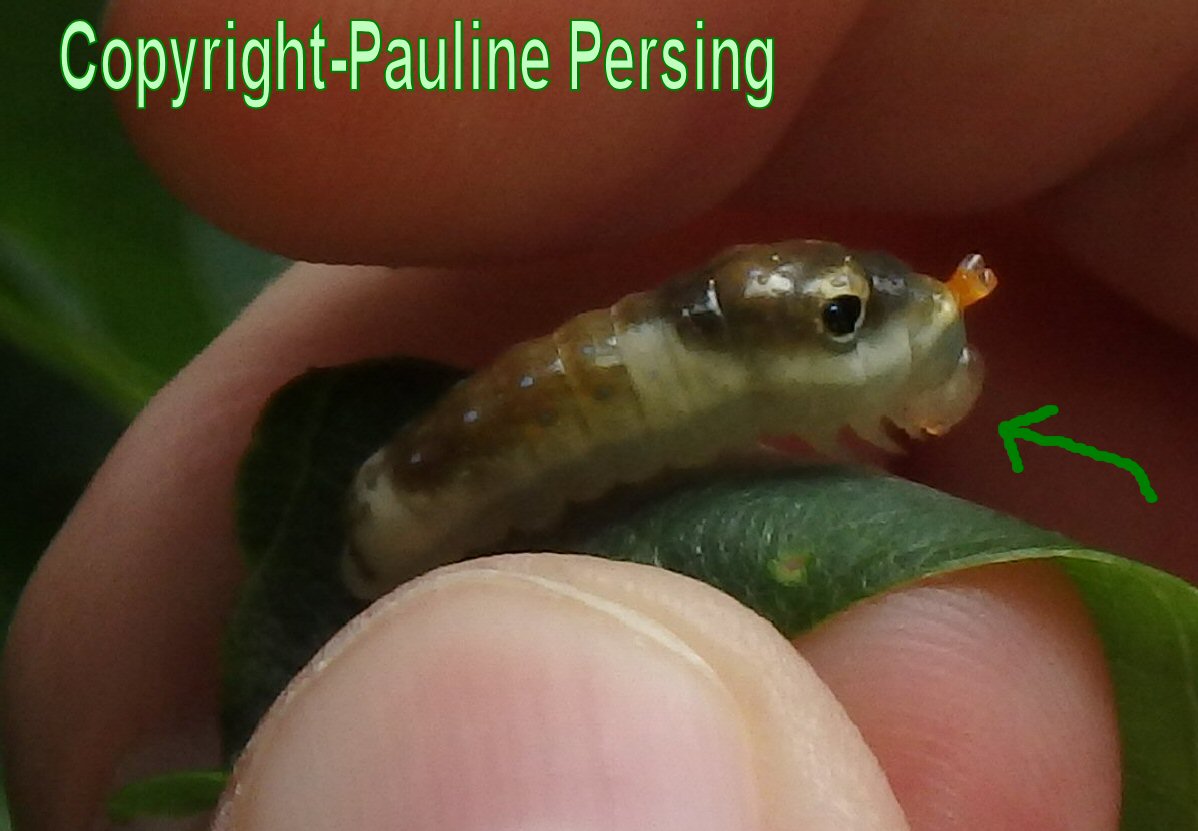
Ruth gently opened a folded spicebush leaf and found the Spicebush Caterpillar.

Larva of Spicebush Swallowtail (Papilio troilus) Wingspan 3.5-5.0 inches (8.9-12.7 cm)

We have been stopping in to see it for three weeks.  Last week I posted a photo that showed what looked like the caterpillar's head.  In this photo its true head is pointed to by the green arrow.  Ruth rubbed the larva enough to disturb it a little and it extended its orange-yellow osmeterium.  This is a defense mechanism which makes it look like a snake.  Normally the structure is folded up in the body.

Larva of Spicebush Swallowtail (Papilio troilus) Wingspan: 3.5-5.0 inches (8.9-12.7 cm)

This is one of the four Eastern Commas that we saw.  We also saw one Question Mark which is a very similar Anglewing.

Eastern Comma (Polygonia comma) Wingspan: 2.0-2.4 inches (5.1-6.1 cm)

During the last two years of walking the transit we have seen many Pearl Crescents.  For some reason, we are seeing very few this year.  Here is the only one we saw.

Pearl Crescent (Phyciodes tharos) Wingspan: 1.25-1.60 inches (3.2-4.1 cm)

Throughout the woods we are seeing Ebony Jewelwings, a species of Damselfly.  This is the male.  The female has a prominent white spot on the ends of its forewings.

                                             
Ebony Jewelwing (Calopteryx  maculata) 1.1-1.4 inches (28-37 mm)

Last year we saw dozens of these shiny orbs on the Stinging Nettles.  We did not see many this year.  We are hoping to someday find out what they are.  Are they eggs or galls or something else?


There is a photo of a Hickory Tussock Moth in  Caterpillars of Eastern North America  by David L. Wagner which shows a similar pattern on its back.  However it has black middorsal tufts.  Ruth is wondering if we found an earlier instar.  Caterpillars look different after each molt.  Most field guides show only the last instar.

Hickory Tussock Moth (Lophocampa  caryae)

We have two species of small blue butterflies in our area during the summer.  We saw a few that flitted away before we could identify which species they were.  This one Tom photographed so we know it is a Summer Azure.  It doesn't have tails like the Eastern Tailed Blue.

Summer Azure (Celastrina neglecta) Wingspan: 0.80-1.25 inches (2.0-3.2 cm)

Ruth notes the blossoming flowers as we walk since they are a source of nectar for the butterflies.  She was pleased to see this Swamp Milkweed.  She planted it last year and wasn't sure that it had lived.

Swamp Milkweed (Asclepias incarnata)