Thursday, October 13, 2011

The 22nd Annual Ohio Renaissance Festival...Oct.15,16...Last Weekend in 2011


This coming weekend is the last one for this year's Renaissance Festival at Harveysville, Ohio. Hours are from 10:30 AM to 6 PM. Once you pay the admission there are lots of free shows on eleven different stages. Many booths feature arts and crafts that you are not likely to find elsewhere. We had never gone to an Renaissance Festival until our granddaughter started working at this one. We missed a lot of years of fun. Every year and every weekend are different.

These are photos Tom took when we went to the festival in September. Enjoy them.


Lots of people come in costume.


Lots of people come in ordinary clothing also.


You can buy or rent costumes.


Sometimes children dress up.


This is one of the rides the children like.


This is a photo taken at one of the many shows.


This piper played at the Swordsmen Theatre.


Every year there are different plays on the Pirate Stage.


There are lots of eating places.


Cast in Bronze played on the Ups and Downs.


Every afternoon there is a human chess match. These are chessmen entering the board. They will battle for their side. Notice the weapons.


The chess match is always attended by Queen Elizabeth I.

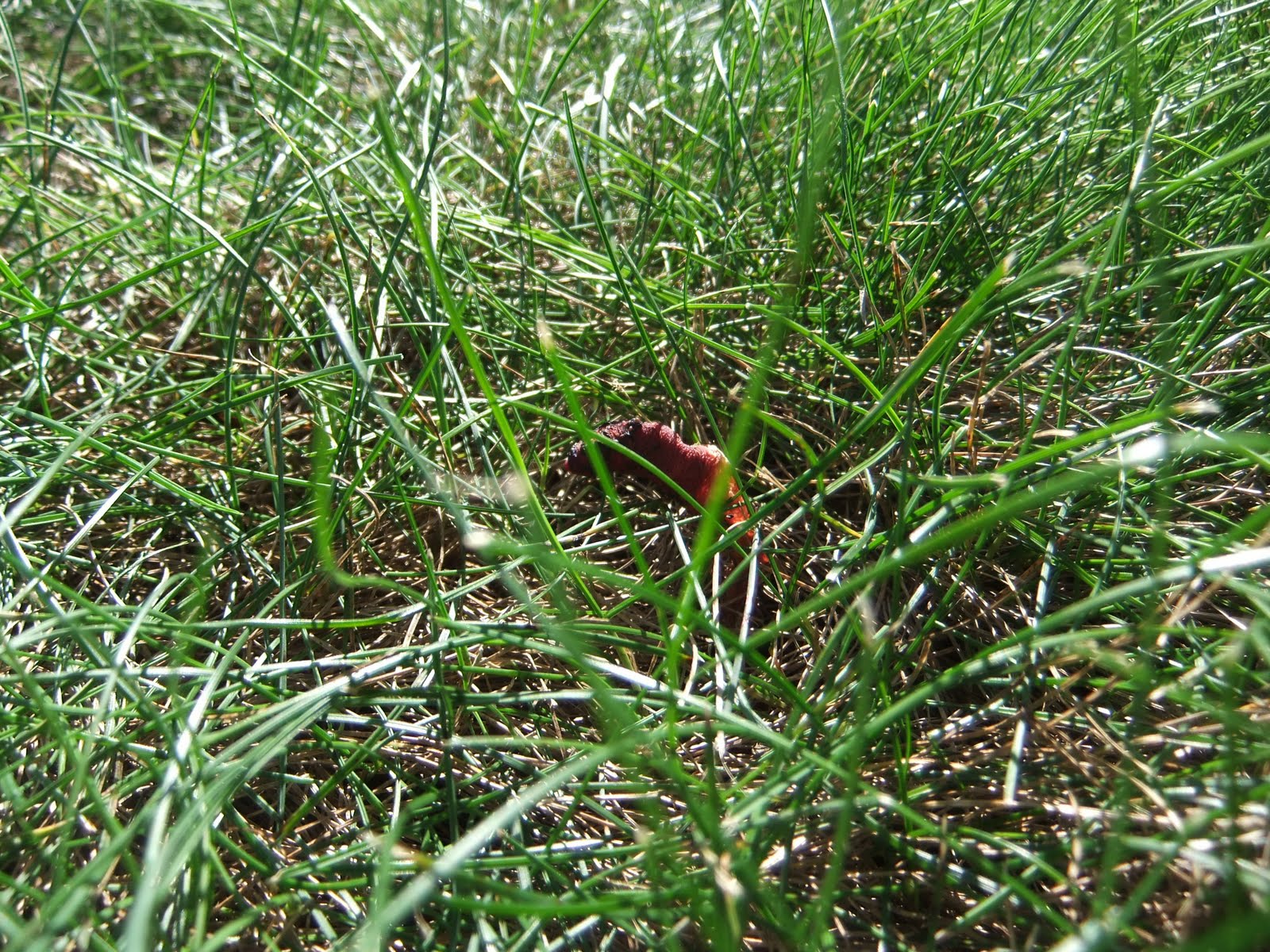
Stinkhorn Fungus

On Monday, October 4, I mowed the grass. On Tuesday, Tom found this in the front yard. I wondered if I had, fortunately, not run a mower wheel  over it or if it had grown there overnight.


I told Tom I thought it was a dog stinkhorn. I was fairly sure I had seen one other fungi like this. I have been learning from naturalists for over thirty years and I vaguely remembered a naturalist identifying it.

The drawing in my copy of Non-Flowering Plants, A Golden Guide, looked similar to the one in our yard, but not exactly like it. I supposed that, like most species in nature, there were a number of similar related species. Although the fungi is called stinkhorn, the write-up in the book said this species did not have a strong odor. My nose isn't as discriminating as it once was but from eighteen inches away, I didn't notice a smell. I decided to use the stinkhorn for this week's blog but I didn't start further research until tonight. (8 PM on Wednesday). I wish I had started on Tuesday. I might have found the egg-like structure these fungi sprout from. Instead I took photos of the fungi nearly every day, watching it grow more and more callused and shriveled


One day I saw small flies and an ant on the fungi. I wondered if they were feeding on it. Tonight, when I finally did some on-line research, I learned that the stinkhorns attract insects with the spore-soaked slime with which they cover themselves. The insects carry off the spores which can then produce another stinkhorn somewhere else.

I also learned that the stinkhorns grow in just a few hours so the stinkhorn had appeared since I had mowed on Monday.

Two sources I consulted were MushroomExpert.Com and America's COOLEST Mushrooms - AmericanMushrooms.com.  Both have a lot of additional interesting information about the stinkhorns.

Tuesday, October 11, 2011

Portrait and Figure Studio, Oct. 6


Our model


Watercolor sketch, 4 minutes, 4 inches by six inches


Watercolor sketch, 5 minutes, 4 inches by six inches

The model sat for four minutes but I continued working on the sketch for an additional minute or two. I had noted a few bits of information that I had not recorded in the first four minutes.


Watercolor, 1 1/4 hours, (three sittings), 8 inches by 10 inches

Adjusting the lips was next on my agenda, but I received a phone call and decided I had to leave.


I worked on the portrait for another hour at home, using the photo I took for information. This is still a sketch and as I look at it, I see changes that could be made but I feel I made progress.

This was the last Portrait and Figure Studio until November. My hope is to continue to do a portrait sketch every week until then.

Thursday, October 6, 2011

The Giant Puffball Mushroom, Calvatia gigantea


On Saturday, September twenty fifth, my friend, the Fungi Finder, and I went for a walk at Charleston Falls. We saw lots of Giant Puffballs off the trail as well as many destroyed puffballs along the trail.


We debated what the reason might be for the destroyed puffballs.

On Sunday, Tom and I went to Charleston Falls again. I wanted to count puffballs and I wanted Tom to see I wasn't exaggerating about the number in the woods. He took his Canon EOS.

He was impressed with the first patch of seven large puffballs, some nearly as large as soccer balls and many bigger than softballs. We saw Dan, one of the rangers, a little further up the trail. The three of us had an interesting discussion about the puffballs and other fungi. He said he knows people who eat the giant puffballs but he doesn't. He says he is wary of eating wild mushrooms.

There is an old saying, "There are old mushroom hunters, and bold mushroom hunters, but there are no old, bold mushroom hunters." The poisonous mushrooms look very much like the edible ones. And among the puffballs, as with the other groups, there are poisonous mushrooms.

He said that a visitor or visitors to the park had destroyed the ones along the trail. It always makes me sad to hear that someone has destroyed a natural living thing just for the sake of destroying it. Mushrooms have an important place in nature. Some are important as decay organisms. They break down logs, leaves, and other organic debris into essential nutrients which are returned to the soil. Some are beneficial to the trees they grow near. They have a special relationship with the tree roots, providing minerals and water to the tree in exchange for glucose.

Dan told us there was a nice patch of puffballs a few steps further up the trail past the main turnoff which most hikers use. After we left him we took the lesser traveled trail and found these three quite close to the trail.


A few steps further, we found these two even closer.


Tom took the photo below to show the size compared to my hand. I wear a Ladies "Large" in gloves so my hand is not dainty. Giant puffballs can range in size from baseball size to beach ball size. Many are soccer ball size.


This mushroom was already a bit past its prime. It wasn't the beautiful pure white of the one I photographed on Saturday with my keyring beside it for a size comparison.

After Tom took this photo he went back the way we had come and I went forward, retracing the route the Fungi Finder and I took on Saturday, counting puffballs as I went. Even walking rapidly, I counted seventeen off in the woods and nine destroyed ones along the trail. Tom found eleven after he left me. That gave us a grand total of twenty eight puffballs.

Tom and I went back on October fourth for another look at the two puffball close to the trail. This time they looked like this. They could almost be mistaken for rocks.


Wednesday, October 5, 2011

The 22nd Annual Ohio Renaissance Festival...The Bubble Sisters


There are two more weekends to see The Bubble Sisters at the Renaissance Festival. Our own Samantha and her friend, Rissa,are The Bubble Sisters. They give two performances each day at the Lorelei Biergarten.


They also warm up the crowd before the human chess game.

Tuesday, October 4, 2011

Portrait and Figure Studio, September 29


6X8 20 minute watercolor sketch, the last sketch of the afternoon. I moved to the other side of the room to sketch this one. I feel more comfortable painting a three-quarter view of a face. I still had trouble with the back of her head. That was the problem I had with the two earlier paintings also. It was just one of those days.

Below is the first pose I painted and then the first sketch of the day followed by the second sketch.


6X8 five minute sketch, the first of the day


7X9.5 inches, three painting sessions of about a half hour each.

When I came home I put my sketches on my easel and critiqued them. I decided I did not have good general proportions so I pulled out three drawing books devoted entirely to drawing heads. I decided to work from Drawing the Human Head by Burne Hogarth.


This is the diagram I used.


This is the correction drawn on a computer copy of the sketch. I also used a transparent grid rather than a ruler to double-check my corrections. I will explain how I used that in another blog.


I left the "extra hair" rather than painting over it so you can see the sketch before correction as well as the after correction in the same painting. As I was writing this, I remembered this pose was one of her short poses so it was not exactly the same as the photo.


7X9.5 watercolor

This is the painting I did during the middle part of the afternoon. I spent about an hour and a half on it, three sessions of a half hour each. This one needed the same proportion adjustments as the five minute sketch. I don't feel it captures the model's likeness or her cheerful personality but every painting is not a success.

Thursday, September 29, 2011

Wonderful World of Insects, a BEEP Unit, Part 2

I taught the Insect Unit twice last week. Here are photos from the second group I worked with.


The Generic Insect is showing off its middle set of legs.


Here are True Bug, Housefly, and Butterfly. Their mouths tell who they are. From left to right a mouth that pierces and sucks, a mouth that works like a sponge, and a mouth that uncoils and siphons like a straw.


A chewing mouth that chews sideways, not up and down. Could be a Grasshopper, a Beetle, or a Dragonfly.


Deb Oexmann, Executive Director of Brukner Nature Center, talked about a Big Brown Bat, a member of the only flying mammal family. We could see that it was making sounds but we couldn't hear them because the sounds are not audible to our ears. She told us that, in winter, some bats hibernate in Ohio and some migrate farther south.


Out in the Brukner meadow, everyone had a turn  sweeping with a net for insects on the plants and  catching insects with plastic bug jars.  The day was barely seventy degrees so the insects were moving slowly.


They caught tiny black beetles with hard wing covers, as well as many species of ants  and bees.  The different species were recognizable by different color patterns and  different sizes.

They learned to identify female and male grasshoppers.  The females had ovipositors which looked like long stiff tails.  They insert these into the ground and deposit their eggs which will overwinter safe from the cold.  They found many species of grasshoppers, some small and some rather large.


Other insects they found included one butterfly and several stink bugs.  They also found flies which were species other than the common housefly.  They could tell this because the flies were small.  Once an insect is an adult its size never changes.

The group caught species from six of the seven groups of insects we discussed before going outside. The missing group was the dragonfly and damsel fly group. The group found many kinds of spiders, an insect relative, also.


Back at the Interpretative Center, the students separated into two teams and played Insect Jeopardy. The categories were Orders of Insects, Life Cycles, Insect Anatomy, This and That, and Insect Predators.