Friday, May 29, 2015

It's official...Banana Slugs String Band Day in Troy, Ohio...May 14, 2015


Mayor Beamish, in the red cap,  presented the official proclamation.  The slugs,  Doug Dirt, Marine Mark, Solar Steve and Airy Larry have been coming to the Miami County Parks for eighteen years to share their Environmentally based songs with children.

Thousands of children, wearing costumes they have made, have come to the Hug the Earth Festival every spring and performed with the band.


Gaia Gary joins the group on their Ohio trips. He has been coming for eighteen years also.  One year he did a remarkable job drumming with his broken arm in a sling.


Thanks, Banana Slugs and Gary.  It's been great fun these past eighteen years.  Hope to see you again next spring.

Thursday, May 28, 2015

Magee Marsh, Metzger Marsh, Ottawa National Wildlife Refuge, Spring Bird Migration

Early this month, May 4, 5, and 6, Tom and I made our annual pilgrimage to Lake Erie to see the warblers stopping there before most of them flew across the lake to their nesting grounds in Canada.

We don't get up early like the truly dedicated birders do who are out at the stopping areas shortly after daylight.  Nor do we continue searching for special species till dark.  But we thoroughly enjoy seeing the birds we find as we casually bird.  My favorite activity is finding a "show-off" bird and watching it for ten or fifteen minutes.

We arrived after lunch on May 4 and birded for three hours on the Magee Marsh Boardwalk.  There was not a huge crowd.  We birded from the van in the parking lot until the light rain stopped.

Photograhers had cameras set up near the entrance platform.  A Scarlet Tanager male and female were having a flirting session.  Here is the male, stopped for the moment and a photographer taking advantage of the situation.


This was a great year for seeing Scarlet Tanagers.  Usually we only see them high in the trees.  This year we saw them flitting among lower branches along the fringes of the woods.

On May sixth Tom and I decided to see what birds were at Metzger Marsh. At the turnaround at the lake edge Tom took this photo.


Below are a few other photos from the trip.


Cape May Warbler


Black-throated Green Warbler


Common Terns


Ruddy Ducks


Tuesday, May 19, 2015

A Short Walk at Charleston Falls, May 17, 2015


The Black Locust trees at Charleston Falls (and throughout the Miami Valley) are in full bloom.  They were the first thing I  noticed when Tom dropped me off in the parking lot.  He said he'd be back after he bought a decaf coffee at a McDonald's about fifteen minutes away.

The day was overcast but I decided to be optimistic.  I left my water resistant jacket in the van and wore my lightweight hoodie.

Black Locust bloom...(Robinia pseudo-acacia)

After taking this photo, I glanced down and saw this.


A Yellow Goatsbeard (Tragopogon pratensis)

They remind me of a dandelion because of their color.  Their "fruit" is a bit like that of a dandelion but much bigger and with a more intricate pattern.  The insect reminds me of a bee but it might be a fly.  There are bee mimics in the fly family.

(June7, 2015  Here is the seedhead taken by Tom.)


I headed down the trail to the falls.  Now and then I felt a drop or two of rain.  I probably should have worn that jacket.

Jack-in-the-pulpit (Arisaema atrorubens)

The Jack-in-the-pulpits were still looking fresh but the Mayapple flowers were fading.  Some had dropped their petals.  I probably will see the fruits (green apples) forming next Saturday.

False Solomon's Seal (also called Wild Spikenard or Showy Solomon's Seal)  Smilacina racemosa)

I was pleased to see this patch of False Solomon's Seal.  One of these flowers blooming by itself does not attract walkers but a patch of them is noticeable.


Close up of flowers


I decided to walk down into the ravine because flowers often bloom there before they bloom on the higher ridges.  The sound of the water pouring over the ledge was soft and calming.  I stopped to enjoy it.

Suddenly I was in a deluge.  I backtracked quickly, hoping Tom was back from his coffee run.  

I stopped long enough to get this photo at the top of the trail. The little spots are raindrops.

I am thankful I now have an Olympus Tough camera.  Among its admirable qualities is being waterproof to 33 feet beneath the water.


Five minutes later I was halfway to the parking lot and the rain had slowed, enough to get this photo of a Waterleaf.  I'll have to come back when the flower is out to identify it more precisely.

Waterleaf (Hydropphyllum)

The flower buds are still in a tight ball.
.

As I knelt down looking at the Waterleaf, I noticed these stems among the Wild Leek or Ramps


 (Allium tricoccum) leaves.  Are they the stems for the Wild Leek Flowers that bloom when the leaves have disappeared???


Friday, May 8, 2015

Burrowing Owls in Cape Coral, Florida, February 27, 2015


Tom and I had already spent most of the day walking at Corkscrew Swamp and we were tired.  But neither of us had ever seen a burrowing owl (Athene cunicularia) and since we were close to Coral Gables, we decided to look.  We had been told that the burrows were marked with the white pipes which was a help.


Burrowing owls are classified as a species of special concern by the Florida Fish and Wildlife Commission.  The burrows, owls and their eggs are protected from harassment and/or disturbance by state law.  The owls are also protected by the federal Migratory Bird Treaty Act.

Tom and I debated about whether the owls lived in other animals' burrows or dug their own.  According to the Florida Fish and Wildlife Conservation Commission, the birds generally dig their own burrows in sandy soil.


The owls hunt during the day as well as at dusk and dawn.  We arrived at the Coral Gables library about 3:30 and watched as we sat in our van in the parking  lot.  No owls. We drove around the block and saw other PVC pipes but no owls. So we went back to our parking place at the library.  Finally at 6:30, just as the sun was going down we decided to take one last tour of the PVC pipes.  This time we were fortunate.


The owl is about the size of Tom's fist.


Tom took 3 photos from the van, then we left the owls to their evening hunt.  But we will have this special birding memory forever.

Monday, April 27, 2015

Corkscrew Swamp Sanctuary

In mid February, Tom and I decided we were tired of cold weather and snow so we headed to Florida to visit friends and relatives and also to do some birding.  We haven't  been to Florida for many years.  There was no way we could do all the things we wanted to do.  But we did those things that were top on our list.  We visited our friends and relatives, then chose some of our favorite side trips from years ago.

Corkscrew Swamp Sanctuary was one of our "must sees".  We wanted to see the Painted Buntings.  They never come as far north as Ohio.  The last time we saw the beautiful little birds was at least ten years ago.


We saw only the males.  The females come a little later.

There have been a lot of changes since the last time we visited the sanctuary.  The lands along the road to the sanctuary are crowded with homes and shopping areas.  Ten years ago, the road wound through woods, swamps and grasslands.

The Interpretative Center is new and much larger.  I like the upholstery on the couch.


There is also a cafe in the center which is very nice.  When we visited the last time the only food was what we brought with us.

The entire walk is now by boardwalk.  Years ago, sections were earthen trails.


The following photos show some of the sights along the boardwalk.


Red-shouldered Hawk


Epiphyte (non parasitic plant growing on another plant)


Blue Flag (I don't know which variety this is.)


Little Blue Heron walking on Water Lettuce (Pistia stratiotes)


The largest cypress trees in the swamp are named for famous regional and national naturalists.  This one is named for Aldo Leopold.


A wide variety of ferns...


Black-crowned Night-Heron...


Signs with natural history and ecological information...


Snowy Egret in breeding plumage...the birds were killed in the early part of the twentieth century for these feathers.  The fashion was to put them on women's hats.


Typical swampy area...


What is this?  It is a part of one of the earlier photos in this blog.


What is this?  Again, it is part of one of the earlier photos in this blog.

Right click on the photos to enlarge them.  Left click to get back to blog.

Wednesday, April 22, 2015

Steve Makes a Polymer Clay Pot


Steve was our house guest for part of his Spring Break.  One day he made a little polymer pot similar to an air dried clay pot he saw on my studio shelf.


He chose three colors of clay...Pink, Ecru, and Green. He used 1/2 package of pink, 3/4  package of Ecru and 3/4 package of Green.

After he used the polymer clay razor-like blade, I realized he could use an old paring knife instead.

I have a set of nesting circular clay cutters.  The smallest cutter that he used was about 1 1/2 inches in diameter.

Cookie cutters would work also.  Something to keep in mind is that polymer clay tools should be used only for the clay, not for food.


The most boring and time consuming part of working with polymer clay is conditioning it...warming it with your hands as you work, making it softer and more pliable.  He softened each piece by squeezing and rolling it with his hands.  Then he rolled the clay with my clay roller.  Any plastic roller will do.  Wood is not slick enough for the job.


Steve rolled, then watched a bit of  TV, then rolled more while I kept track of his progress on the conditioning.

When the clay was rolled thin enough to roll through the pasta machine, he switched to using it.  He enjoyed using this tool.


He passed the clay through the pasta machine until the clay was still softer.

Then he formed each flat section into a "snake".


After he had his three "snakes" made he twisted them together.


When the multicolored "snake" grew long, he broke it into two pieces and twisted them together.


 The more the "snake" is twisted the more the colors will mingle.  Eventually he had the "snake" twisted to his satisfaction.


He shaped it into a thicker shape by folding it in half and squeezing and rolling.


I still hadn't figured out that he could use a paring knife for cutting at this point so he used my clay blade being VERY careful.


He rolled the portion he cut off into a ball and then flattened it with the roller.


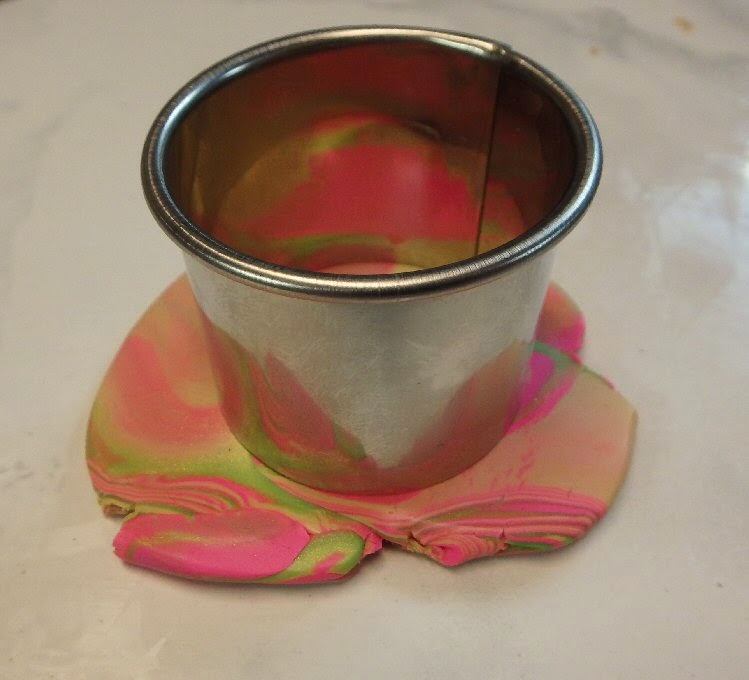
He used the middle-sized cutter to cut the base of the pot.


He cut off the portion for the sides of the pot, leaving enough to make the three piece lid.


Next came rolling the side portion lengthwise to stretch it long enough to fit around the base.


He checked to see if the piece would wrap entirely around the base.


He rolled the piece a little longer.


Then he laid a ruler on the clay and cut down both sides of the ruler using an old paring knife.  I helped him hold the ruler.  You can see the base for the pot at the bottom of the photo.


He wrapped the rectangular piece around the base and pushed it gently against it so it would adhere.


The lid was next.  He made the circle exactly as he had made the base circle but he used the largest cutter.


He made the underside insert for the base using the smallest cutter.  The underside insert is centered on the lid and keeps the lid from falling off the pot.  This photo does  not show this very well.


Perhaps you can see it better on the lid of the air-dried pot.


On the top side of the lid he pushed down a ball of clay for the handle.


I baked the two pieces side by side in a 275 degree oven for 25 minutes.


And here is his pot.


He told me it would be a good container for earrings.  He decided it would be a good container to hold coins, also.