Monday, July 20, 2015

July 11..Will this day be the best butterfly transit walk of 2015 at Brukner?


There were a lot of photographers on July 11 and many photo opportunities.  Here we are walking along the drive back to the Dumpster in the parking lot where we started our walk.  We are counting  Red Admirals.  We saw at least 40, most of them along the drive.

 Red Admiral (Vanessa atalanta) Wingspan 1.75-2.50 inches (4.4-6.4 cm)

They were fresh and brightly colored.  No torn wings.  They must have emerged from their chrysalises within the last day or so.

We saw Great Spangled Fritillaries along the drive and earlier on our walk, too.  Some of the fritillaries were raggedy.  They have been around for a week or more.  We counted at least nine.


Great Spangled Fritillary (Speyeria cybele) Wingspan:2.9-3.8 inches (7.1-9.7 cm)

Small Eastern Milkweed Bugs have reached the adult stage.

Small Milkweed Bug (Lygaeus kalmii)

The Red-Spotted Purple was too far away to count but was clearly visible through binoculars that some of the group carried.

Red-Spotted Purple (Limenitis  arthernis astyanax) Wingspan 3.0-4.0 inches (7.6-10.2 cm)

Beside the Interpretive Center and throughout the woods we saw Northern Spring Peepers. I was pleased to finally see them. Tom had never seen them either.  I was amazed to see how tiny they were, about the size of a dime.  Tom and I have heard their mating choruses in the spring.  They sing  songs loud enough for  much larger creatures
.


Three photos of Northern Spring Peeper (Pseudacaris crucifer crucifer)  Length .75-1.25 inches (2-3 cm)

Ruth gently opened a folded spicebush leaf and found the Spicebush Caterpillar.

Larva of Spicebush Swallowtail (Papilio troilus) Wingspan 3.5-5.0 inches (8.9-12.7 cm)

We have been stopping in to see it for three weeks.  Last week I posted a photo that showed what looked like the caterpillar's head.  In this photo its true head is pointed to by the green arrow.  Ruth rubbed the larva enough to disturb it a little and it extended its orange-yellow osmeterium.  This is a defense mechanism which makes it look like a snake.  Normally the structure is folded up in the body.
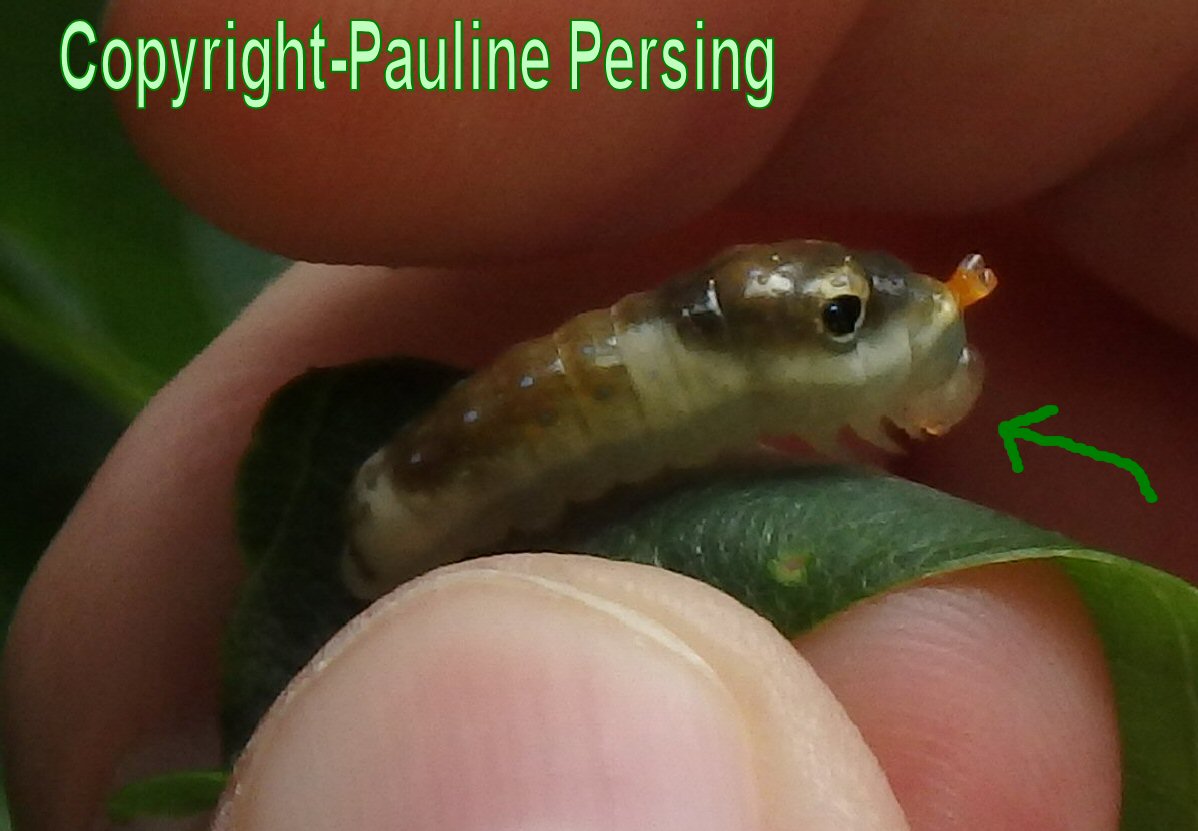
Larva of Spicebush Swallowtail (Papilio troilus) Wingspan: 3.5-5.0 inches (8.9-12.7 cm)

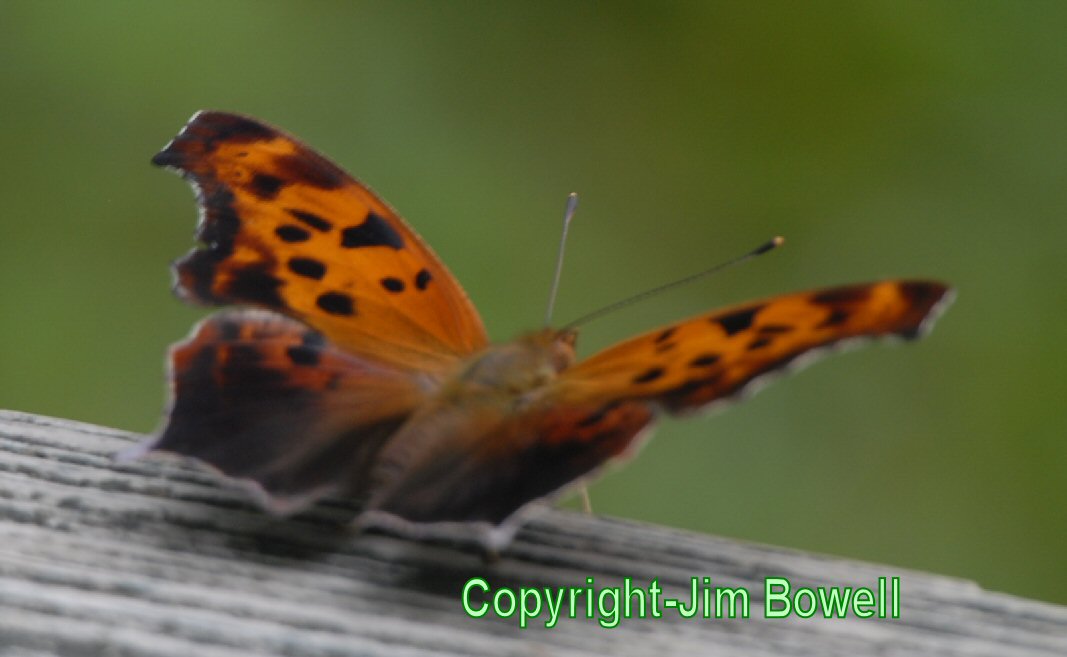
This is one of the four Eastern Commas that we saw.  We also saw one Question Mark which is a very similar Anglewing.

Eastern Comma (Polygonia comma) Wingspan: 2.0-2.4 inches (5.1-6.1 cm)

During the last two years of walking the transit we have seen many Pearl Crescents.  For some reason, we are seeing very few this year.  Here is the only one we saw.

Pearl Crescent (Phyciodes tharos) Wingspan: 1.25-1.60 inches (3.2-4.1 cm)

Throughout the woods we are seeing Ebony Jewelwings, a species of Damselfly.  This is the male.  The female has a prominent white spot on the ends of its forewings.

                                             
Ebony Jewelwing (Calopteryx  maculata) 1.1-1.4 inches (28-37 mm)

Last year we saw dozens of these shiny orbs on the Stinging Nettles.  We did not see many this year.  We are hoping to someday find out what they are.  Are they eggs or galls or something else?


There is a photo of a Hickory Tussock Moth in  Caterpillars of Eastern North America  by David L. Wagner which shows a similar pattern on its back.  However it has black middorsal tufts.  Ruth is wondering if we found an earlier instar.  Caterpillars look different after each molt.  Most field guides show only the last instar.

Hickory Tussock Moth (Lophocampa  caryae)

We have two species of small blue butterflies in our area during the summer.  We saw a few that flitted away before we could identify which species they were.  This one Tom photographed so we know it is a Summer Azure.  It doesn't have tails like the Eastern Tailed Blue.

Summer Azure (Celastrina neglecta) Wingspan: 0.80-1.25 inches (2.0-3.2 cm)

Ruth notes the blossoming flowers as we walk since they are a source of nectar for the butterflies.  She was pleased to see this Swamp Milkweed.  She planted it last year and wasn't sure that it had lived.

Swamp Milkweed (Asclepias incarnata)

Friday, July 10, 2015

July 5, Sunday...Butterflies on the Brukner Butterfly Transit

While I was taking photos at John and Jacquie's wedding, my butterfly loving friends were taking photos on the Brukner Nature Center's Butterfly transit.

Red Admirals were the most abundant species just as they were the previous week,  Twelve of them were within the transit parameters.


Three photos featuring the Red Admiral (Vanessa atalanta) Wingspan: 1.75-2.50 inches (4.4-6.4 cm)

The Great Spangled Fritillary's wings are looking worn on the edges.  This is one of six that the group saw.  Like the Red Admirals, it is nectaring on Purple Coneflowers (Echinacea purpurea).  These flowers are a favorite source of nectar for a variety of butterflies.

Great Spangled Fritillary (Speyeria cybele) Wingspan: 2.9-3.8 inches (7.1-9.7 cm)

It is always nice to get a clear photo of a Cabbage White.  They are a common butterfly but they tend to flit about,  landing only among plants where it it difficult to get a clear view of them through the camera lens.  Because this one has two spots on its forewings, we know it is a female.

Cabbage White (Pieris rapae) Wingspan: 1.5-2.0 inches (3.8-5.1 cm)

The Wild Indigo Duskywing is a dainty butterfly with a lovely muted pattern which shows up nicely on a sunny day.

Wild Indigo Duskywing (Erynnis baptisiae) Wingspan: 1.3-1.7 inches (3.3-4.3 cm)

This monsterous face belongs to the Spicebush Swallowtail larva.

Larva of the Spicebush Swallowtail (Papilio troilus)  Wingspan: 3.5-5.0 inches (8.9-12.7 cm)

Because we are looking for larva we sometimes find other small creatures.  Ruth took this photo of a Northern Spring Peeper (Pseudacaris crucifer crucifer) with her iPhone.


Tuesday, July 7, 2015

Almost Caught Up on Butterfly Transit Blogs...Butterfly Transit June 28, 2015

I have had other activities besides butterfly transits on my agenda these past few weeks.  We now have a new Pressure Tank for our water system so there is no longer water on the basement floor,  Tom is on the homestretch with the park district videos which takes a lot of computer time so, instead of working on the computer, I have been reading on the new Kindle I won in a raffle at the library.

The happiest event was the wedding in the family on July fifth.  John, known as Sean when he was young, is the first of our grandchildren to marry.  The wedding was lovely.


And now, to the butterflies seen on June 28...

There was a big group walking and looking.  Jim and Phil took photos.


The Great Spangled Fritillaries (Speyeria cybele) Wingspan: 2.9-3.8 inches (7.1-9-7 cm) are showing up in increasing numbers at Charleston Falls and in our yard as well as at Brukner on the transit where two were counted.


I haven't seen huge numbers of Eastern Commas (Polygonia comma) Wingspan: 2.0-2.4 inches (5.1-6.1 cm) but there always seem to be a few around.  Two were seen on the Butterfly Transit.


Eleven Red Admirals (Vanessa atalanta) Wingspan 1.75-2.50 inches (4.4-6.4 cm) were spotted, the largest number of any one species seen on the June twenty-eighth transit.


The American Snout (Libytheana carinenta)  Wingspan: 1.6-1.9 inches (4.1-1.8 cm) was a special butterfly for the day.  They are not often identified though there may be more of them around than we realize.  Positive Identification is provided by the photos below. The "snout" is visible.  The snout is actually its long pointed palpi.


It takes a fast finger on the camera button to get a photo of an Eastern Tailed Blue (Everes comyntas) Wingspan: 0.75-1.00 inches (1.9-2.5 cm)  They never stop for long. This one is a female.


The group is getting better at spotting and photographing the little mostly brown butterflies.  This is a Banded Hairstreak (Satyrium calanus) Wingspan: 1.00-1.25 inches (2.5-3.2 cm)


Ruth thinks this is most likely a Little Glassywing (Pompeius verna) Wingspan 1.0-1.5 inches (2.5-3.8 cm).  The Glassywing, the Dun Skipper and the Northern Broken Dash look similar but not exactly the same.  The Little Glassywing has distinct translucent white spots on its forewing.


This is most likely the Northern Broken Dash (Wallengrenia egeremet) WingSpan: 1.0-1.5 inches (2.5-3.8 cm).  The markings on the wings are slightly different.  There are no translucent white spots on its forewing.


The group also saw larva.


This looks like  Spicebush (Papilio troilus) caterpillar.  We saw a larva a week ago.


In the past, we have seen the most butterflies in July.  We are all looking forward to the month.

Saturday, July 4, 2015

Butterfly Transit, June 20 and 21,2015...More new sightings for me

Ruth and Jim were selling plants at the Brukner Nature Center's Native Plants Sale on Saturday so the three of us didn't start our walk around the transit until late afternoon.

I was glad I came because I saw Wild Indigo Duskywing chrysalises. I've never seen them before. Ruth counted ten.  There may have been more.Below are three  photos of them.


Wild Indigo Duskywing (Erynnis baptisiae)  Wingspan: 1.3-1.7 inches (3.3-4.3 cm)  This photo was taken on a butterfly transit walk earlier this year.


The second new sighting for me was this Spicebush swallowtail larva on the spicebush in Brukner's Butterfly Garden.  I hope we get to see an adult later this summer.


While Ruth was selling plants she took time out to capture this Banded Hairstreak (Satyrium calanus) Wingspan: 1.00-1.25 inches (2.5-3.2 cm).  It couldn't be counted as part of the transit sightings because she wasn't walking the transit when she caught it.


Ruth and Jim saw so many butterflies while they were selling Native Plants on Saturday, they decided to walk the transit again on Sunday.  They saw most of what we saw on Saturday plus six additional species.


I think this is the first Tawny Emperor (Asterocampa clyton) Wingspan: 2.00-2.75 inches (5.1-7.0 cm) we have seen this year.  Jim took a photo of it with its wings spread and also one with its wings closed.  This is not an easy task when the day is warm because the butterflies don't stop for long.


After Jim captured a photo of the underside of the Tawny Emperor he compared it with a photo of the underside of a Hackberry Emperor.  The two photos made a good comparison composite photo.


Below is a Question Mark (Polygonia interrogationis)  Wingspan: 2.25-3.0 inches (5.7-7.6 cm) is hard to tell from the other Anglewing, Eastern Comma, Wingspan: 2.0-2.4 inches (5.1-6.1 cm)  unless the butterfly folds its wings long enough for the viewer to see whether the silver marking on the underside of the hind wing is a curved "comma" or a two part "question mark".


The colors and details of the Mourning Cloak (Nymphalis antiopa) Wingspan: 3.0-4.0 inches (7.6-10.2 cm) show up beautifully in this photo.


Either there are more skippers showing up on our butterfly transit this year or we are better at finding them.  

Below is the Delaware Skipper (Anatrytone logan) Wingspan: 1.0-1.4 inches (2.5-3.6 cm) one of the more colorful skippers.