Showing posts with label Ohio History. Show all posts

Tuesday, September 12, 2017

Saturday of Labor Day Weekend, Sept. 2017

Henry came again to visit because Sonja was in the process of moving from one house to another.  I know Henry had more attention from us than Sonja had time to give him.

Steve came to visit, too.  

One Saturday, Steve and I went to the Fort Rowdy Gathering in Covington.  This was the twenty-fifth year for the event.  Years ago I took Steve's brother to the gathering.  The gathering is a little larger now but still uncrowded and easy-going.

The gathering is on two open grassy areas surrounded by trees, one area on either end of a bridge across the Stillwater River.  The bridge is rebuilt every year for the weekend and then taken down.


Close to the shore, Steve spotted a school of several hundred tiny fish swimming fast and away from us.

Life in the encampment is old style camping.  There is a native American encampment as well.


Arts and crafts are demonstrated and sold on both sides of the bridge but they are somewhat different.  On the near side there are painted gourds and fine needlework and other crafts that a person finds at a typical craft show.  On the far side are the craftmen and women who make the kind of crafts Daniel Boone would have found useful.  One craftsman we talked to was making a water jug from leather.  The crafts are laid out on blankets or tables or hung on racks.


There was music on the tents on both ends of the bridge as well.  The old, old songs the settlers brought from Europe were sung on the far end encampment.  The listeners sat on straw bales.


As Steve and I headed back to the bridge because we were hungry and the food booths were on the other side, we saw a boy fishing.  He caught a little blue gill and threw it back in to grow larger.


View from halfway across the bridge.


 On the near end, the music was more modern country music.  There were amps set up as well as bleachers for the listeners to sit on.


This festival is a money making event for local non-profit organizations.  Steve and I bought lunch from the boy scouts...brats and kraut and mashed potatoes.  For dessert we had homemade apple dumplings and ice cream from the booth next door.

Wednesday, July 26, 2017

Bigelow Cemetery State Nature Preserve, Madison County, Ohio


After I wrote the blog about the Royal Catchflies in our yard and our experiences with them, Tom and I decided it was time to make the excusion to see Bigelow Cemetery State Nature Preserve, the place where we first saw Royal Catchflies.

The first time I saw the cemetery was with a group of volunteers from Brukner in the early nineteen eighties.  This sign had not been erected.  Naturalists in Ohio had only recently become interested in the prairies that appear here and there in Ohio.


Tom and I have been here many times over the years. The first times he and I both walked the paths. Now Tom waits in the van while I explore.  He brought a book along to read while I walked for forty minutes.


The trees in the distance are Burr Oaks, the tree associated with Ohio prairies.  Its tough thick bark can withstand prairie fires.


This monument marks the burial spot of Stephen Smith, age 11, who died in 1833. The earliest tombstones date to 1814 and the last known burial was in 1892.


                                          Prairie Dock


This is the gravestone of Dr. William King.  He "Died April the 14th 1844  Aged 30 years 11months and 5 days".  Many of these stones have the exact day of the person's death described like this.  It makes me feel that people appreciated every day that they lived.  Below, mostly hidden by the flowers is a message:
"My glass has run, my grave you see
In time prepare to follow me.
Go home dear friends and dry your tears,
I must lie here til Christ appears.
And when he does, i hope to rise
Unto a life that never dies."

                                        Sainfoin (Scurf-Pea)

Mostly Gray-headed Coneflower, two Purple Coneflowers, and two Royal Catchflies.  Burr Oaks in the background.

                     Honeybee on Wild Bergamot

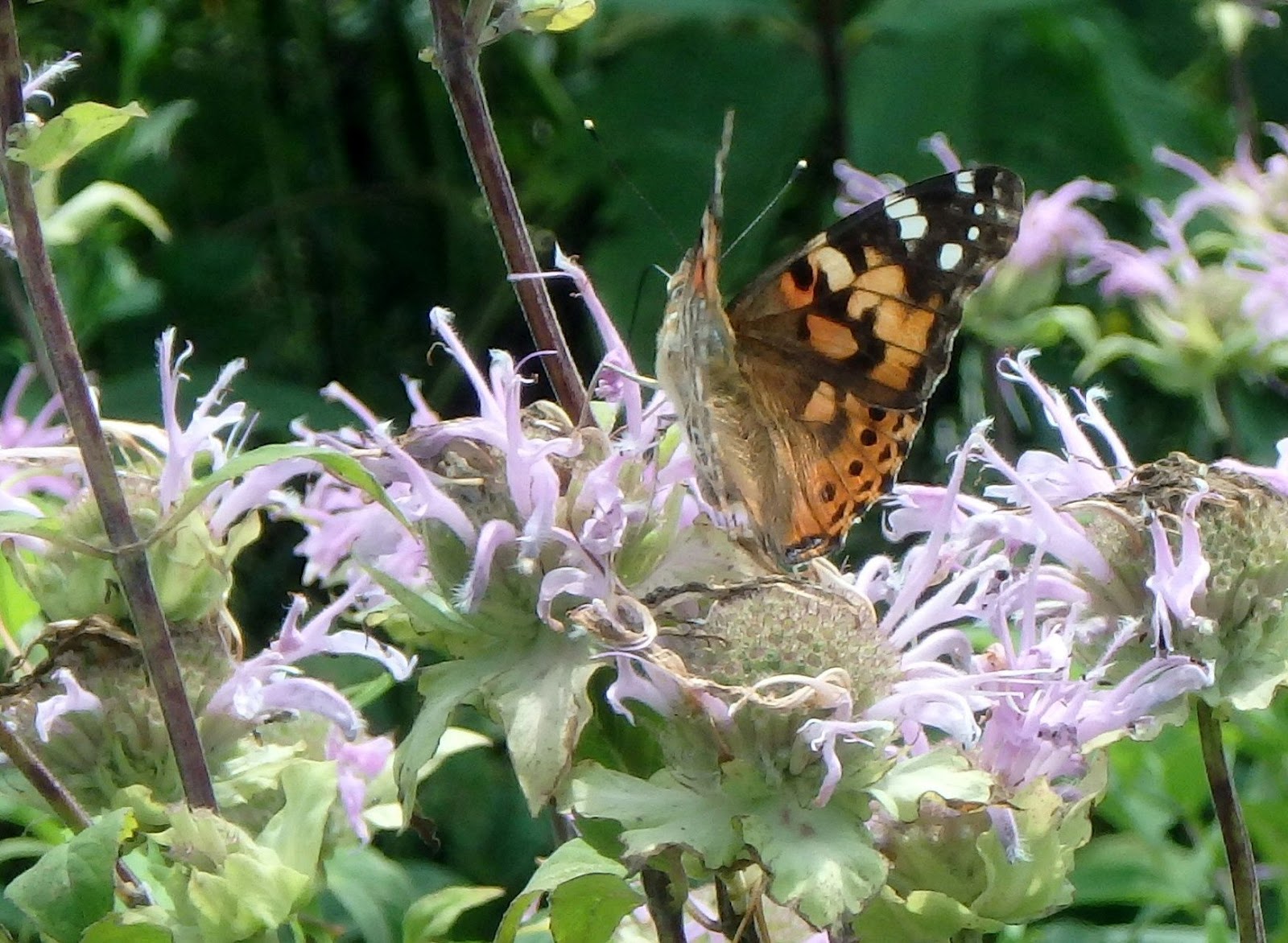
                               Painted Lady

Leaves and developing acorns of the Burr Oak

Various prairie flowers.

In this photo, you can get a good look at the calyx beneath the red petals.  The calyx is sticky which is why the plant is called a "catchfly".

I saw a Ruby-throated hummingbird at least a half dozen times nectaring at the Royal Catchflies but I wasn't as fast with my camera as the hummingbird was with his wings.  I'll just have to keep him in my memory.

Thursday, September 17, 2015

Abraham Lincoln has been visiting in Troy.


Abraham Lincoln and Common Man have been talking all summer on the front lawn of the Miami County Courthouse.


I stopped in last week and a passing woman took my picture with them.  They are truly giants among men.

Since 2003, Troy has been having biannual public art exhibits.  Usually the sculptures are scattered throughout the downtown area.  This year, the sculpture is this gigantic one.

I checked on the Internet and this is what I learned.

The thirty-one foot high sculpture was created by Seward Johnson from a smaller one commissioned by The Lincoln Fellowship of Pennsylvania.  That piece is in Gettysburg, Pennsylvania.

Twice before Troy has had sculptures by Seward Johnson as public art displays.  Funding for the displays is obtained through grants and donations.

As a special addition, a full-size replica of the Lincoln Funeral Train was on display September 10 through 13 on Short Street between Hayner Cultural Center and the courthouse. Every time I went by long lines of people were waiting to tour the funeral car.  I didn't tour it but here is a photo of it followed by photos of the engine and the complete train.


The original funeral train traveled across Ohio in 1865, stopping at towns along the way.  One of the stops was at Piqua, a few miles north of Troy.

Tuesday, November 19, 2013

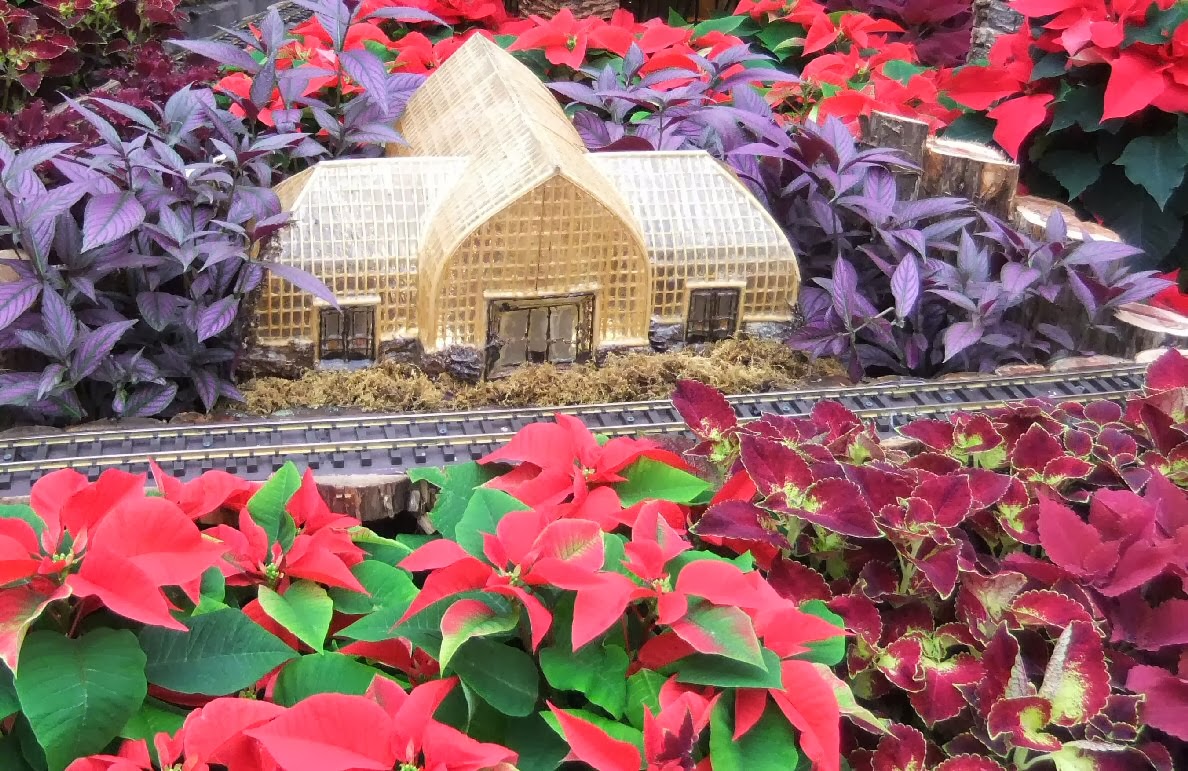
Cincinnati Scenic Railway at the Krohn Conservancy


Tom, Stephen, Ray, and I went to the conservatory's Christmas exhibit this past weekend.  Here are a few photos from the exhibit.  The model above is of the conservatory which is about eighty years old.

Below is about half of the model of the Roebling Bridge that spans the exhibit.  The bridge was opened to traffic between Cincinnati, Ohio and Covington, Kentucky in 1867.  It was declared a National Historical Landmark in 1975.


Beyond the bridge to the left, two bluish towers are part of the model of the Proctor and Gamble General Offices.  The curved bridge visible beneath the engine on the bridge and beyond the closest visitors  is known by Cincy residents as the Big Mac because the actual bridge is painted bright yellow so it looks like McDonald's Golden Arches.

This Big Mac is not painted gold.   Instead the entire exhibit is constructed from natural materials.


You can see the construction materials in this railroad crossing sign.


It is fairly easy to see the natural materials on this hand shaped control for the Thomas the Tank Engine section.


The steamboat is part of another interactive exhibit.   The smokestacks puff out smoke when activated by the handshaped control.


A volunteer told us that every year something is added to the exhibit.  This year the Great American Insurance Company building was added.


Other buildings in the exhibit include the childhood home of William Howard Taft, the twenty-seventh president of the United States (left front) and the Union Terminal (upper right).


Monday, June 24, 2013

Garst Museum in Greenville, Ohio


This is the parlor of the Garst House, now part of the Garst Museum.  Twenty years ago, Pat took Ceceila and me to this museum which is noted for its display of memorabilia of  Annie Oakley.  What I remembered most were Annie's beautiful clothes, the costumes she wore in the Wild West Shows and the evening gowns she wore when she was presented to presidents, kings, and queens.  I asked Tom to take me to the musum as part of my birthday celebration.  Here are photos of some of what we saw.


The museum doesn't look like it did twenty years ago.  There have at least two large additions built.

 Because Tom uses a scooter, we entered through the handicap entrance which is at the end of the usual tour.  The people in the office were pleasant, gave us maps and explained a bit about what we would see.

In the same area which was a large meeting room, we saw the first mention of Annie Oakley, little Miss Sharpshooter.


Greenville was originally a fort in the Northwest Territory, number 5 on the map.  It was here that a treaty was signed by "Mad" Anthony Wayne and native chiefs which opened Ohio to settlements by the new country of  the United States.    One section of the museum is devoted to the treaty and the events about it.  A nearby room gives information about native American cultures.


But back to our tour path.  Since we were walking the tour backward, we came first to the large display about transportation.


Twenty years ago, I don't believe this section of the museum existed.  Some of the vehicles were shown but not in an organized way as they are now.


The Iddings Special, a racing sprint car made in 1947 by Henry Meyer and originally powered by a 4-cylinder Offenhauser engine.


1947 model "Servi-Car" , a three-wheeled motorcycle made by Harley-Davidson for use by the Greenville Police Department.

The next large wing was called The Village Wing .  There were many shops whose windows we could look through to see an earlier way of life.


                                          The dentist's office


                                         The post office

Beyond this area were two rooms and a hall devoted to Annie Oakley.  (The musical, "Annie, Get Your Gun", is a fanciful version of her life.)  Her riding habit worn in later years was there and so was a robe that Frank Butler, her husband, gave her after they retired.  Here is her traveling trunk with show business memorabilia  displayed on it.


One room was centered around her personal life and the other room, around her professional life. 

A hall was filled with commercial products featuring Annie.  Here is one display.


BUT, all the beautiful gowns she wore when she was presented to the great people of her day were missing.  I was told they were..." being preserved in storage so they will not deteriorate."  I have seen much older clothing on display in other museums.  I am sorry to say I let not seeing the clothing affect my mood. I actually felt like crying.  I told both women I talked to I felt a portion of Annie's life was missing.  I had no idea she wore such beautiful stylish gowns until Pat brought me to the museum years ago.