Showing posts with label Charleston Falls. Show all posts

Friday, July 26, 2019

A Walk at Charleston Falls with Tom...July 23, 2019


Tom and I loaded up Tom's old power chair and headed off to look at flowers.  His new chair is   wonderful but it is not as powerful as the old one.  Since Charleston Falls has hills, power is important.

We saw butterflies at the new entrance to the trail. Tom took photos.  Our first thought was that they were Pearl Crescents...


But then Tom enlarged the photo and we could see that they were Silvery Checkerspots.


Then we moved a few steps further and he got to see the Rain Garden for the first time.


The Queen of the Prairie that I saw had finished blooming but Tom spotted a Cardinal Flower and the Rattlesnake Master..


and a lavender blue one that we think is a Monkeyflower.  I didn't know until I was looking through my wildflower field guides at home that I should have checked for a square stem.


We were off to a good start.


Tom stopped to take a photo of the falls through the trees.

We turned off toward the Octagon Prairie...


Tom with his camera...


Me with my camera.


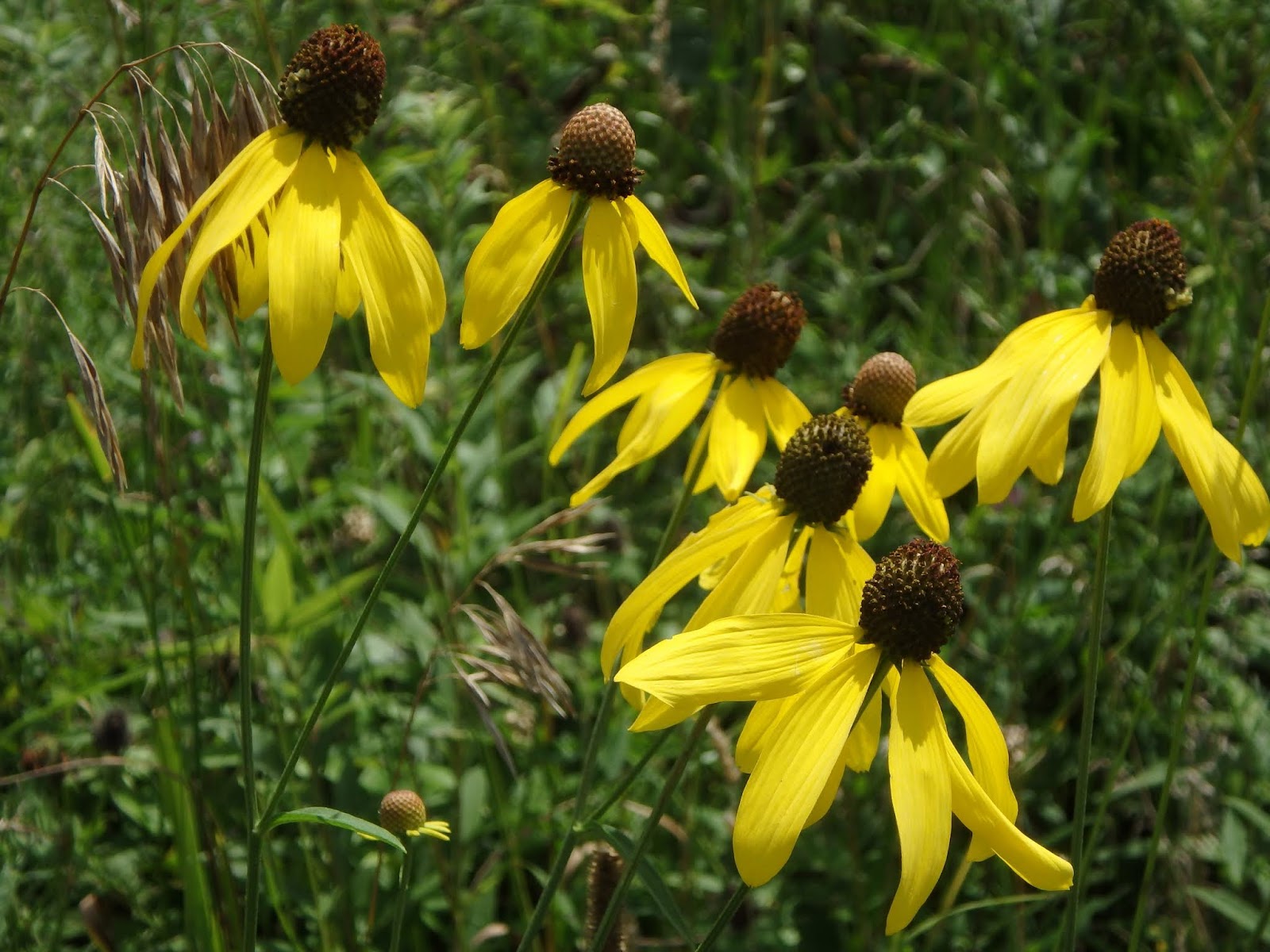
Tom stopped to take a few close-ups of Gray-headed Coneflowers...


He looked at the other side of the trail and said,  "Look, there is a Viceroy butterfly."

I took these pictures.


And Tom took this one.


Deptford Pinks are an alien species but I have never seen more than a couple plants in any one spot.  They don't appear to endanger the native species.  They are tiny.  I never knew they were spotted with white until I took a photo of one and enlarged the photo.

Wednesday, July 17, 2019

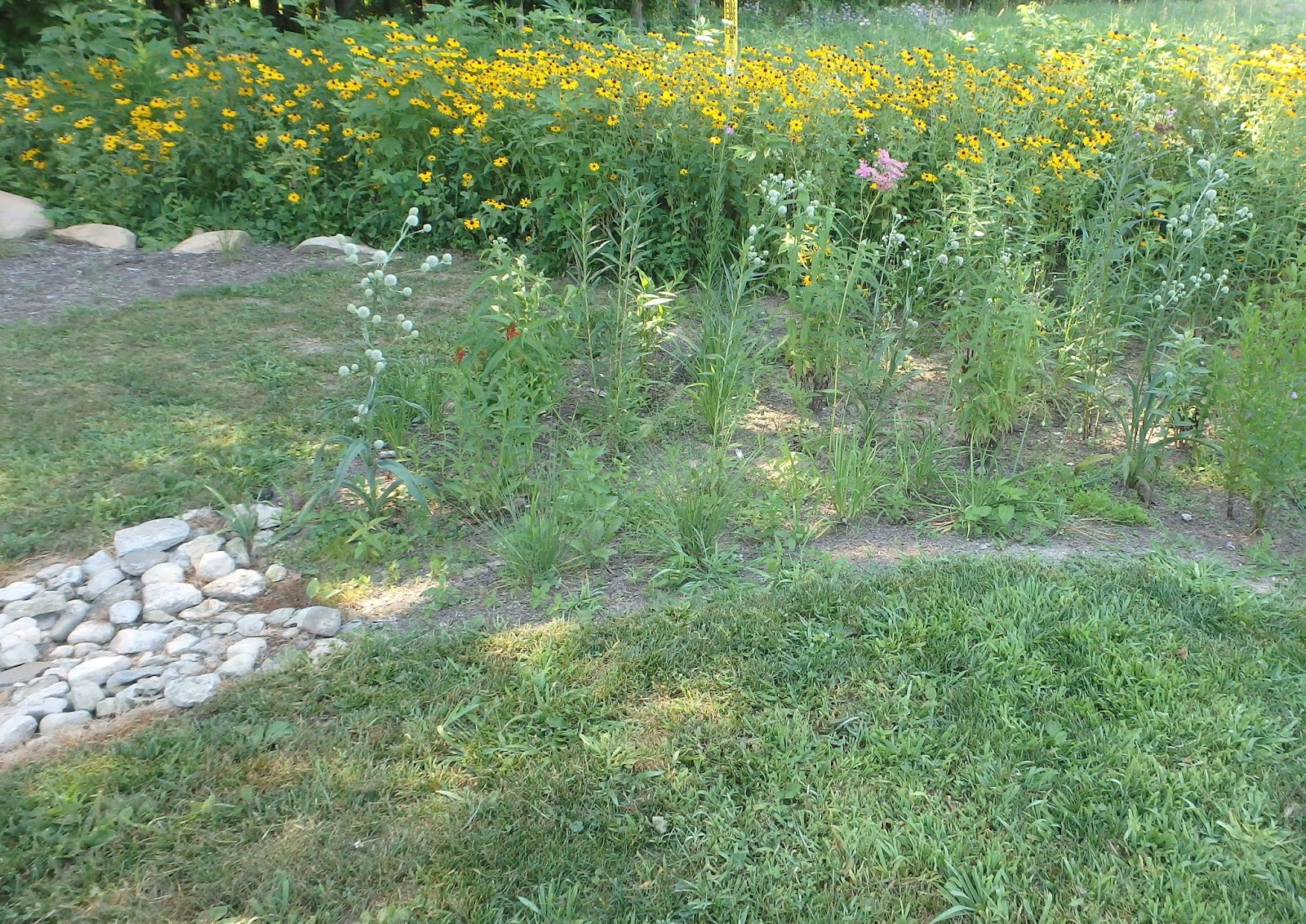
The Rain Garden at Charleston Falls, July 13, 2019

I sat down to write this and realized I hadn't taken notes or pictures of everything to tell this story.  When I saw the prairie plants flowering in the Rain Garden near the entrance to the trails at Charleston Falls, all I thought about were the blooms.

I know Rain Gardens, whether planted in a a natural depression or in a dug out depression, are meant to drain water and are usually wet only seasonally or after heavy rains.  The flowers that grow on tall grass prairies are adapted to land which is wet in spring and dry in the summer so prairie plants and Rain Gardens complement one another.


A section of the Rain Garden at Charleston Falls.  The rock covered dip to the left of the photo slopes down from the paved gathering place for groups.

And in the depression, I saw....


the round flower heads of Rattlesnake Master and Queen of the Prairie.  The yellow Black-eyed Susans, (Rudbeckia hirta) are on the higher ground of the rest of the planted prairie.

I usually have to go to Garbry Big Woods Preserve to see the Rattlesnake Master and to Aullwood Audubon Center to see the Queen of the Prairie.   Seeing the two plants made my walk one to remember and I hadn't taken a step into the peaceful woods.

Closeup of the Rattlesnake Master, (Eryngium) ...

Each bud will open exposing a tiny flower.

A closer look at the Queen of the Prairie (Filipendula rubra) ...


Friday, July 27, 2018

A Walk at Charleston Falls, July 24...Wonderful day for seeing butterflies

It was a beautiful day for a walk.  It was cooler than it has been, only about eighty degrees, Fahrenheit, the humidity was low, the sun was shining.

Shortly after I turned off the main trail I saw butterflies dancing everywhere.  I assumed they were Pearl Crescents since they are a common species.  But when I looked at my photos I discovered most of them were Silvery Checkerspots, a butterfly I had never heard of until Ruth Bowell told me about it when I was walking with the butterfly Transect group at Brukner Nature Center.

After enlarging this on the computer I am fairly sure this  is a female Pearl Crescent. (Phyciodes tharo)    Wingspan: 1.25 -1.60 inches (3.2-4.1 cm)

I assumed this was a male Pearl Crescent. However, back home, I looked through my butterfly field guides and I decided it is a Silvery Checkerspot (Chlosyne nycteis)  Wingspan: 1.4-2.0 inches (3.6-5.1 cm  It has the two white spots in the row of black spots on the hind wings.


Soon I came across a cluster of butterflies clearly enjoying whatever they had encountered on the ground.  I didn't look too closely at their treasure because they might have been enjoying poop of one kind or another and I wasn't in the mood for poop. I was still assuming that I was seeing Pearl Crescents.  When I enlarged this on the computer, I discovered that although I had assumed they were Pearl Crescents, most of them were Silvery Checkerspots. 

In this still photo taken at the butterfly gathering spot, I have pointed out another distinguishing characteristic of Silvery Checkerspots.

According to the field guide, Butterflies of Ohio, a field guide by Jaret C. Daniels, Silvery Checkerspots fluctuate in population from year to year in Ohio, locally common sometimes and other times nearly absent.  This is why I automatically assumed I was seeing Pearl Crescents.  I was amazed when I looked at this video on the computer and discovered these were mostly Silvery Checkerspots.  Daniels further commented that the "males often gather at damp soil or animal dung".


Now I am not sure whether this is a Pearl Crescent female but I am still tending to think it is.
                                     ********************************************

Of course, at the time I was just enjoying the dancing butterflies, the sunshine and the flowers.

On my return walk through the area a Hackberry Emperor stopped close enough on the path for me to get this photo.

Some of them were enjoying the same "treasure spot" as the Silvery Checkerspots.

Out on the prairie , a Silver-spotted Skipper (Epargyreus clarus) Wingspan: 1.75-2.4 inches (4.4-6.1 cm) took its time nectaring from a teasel. 

The other butterflies flitted by too fast for me to photograph...Cabbage Whites, Eastern Tiger Swallowtail, a dark swallowtail with lots of yellow dots on its body, several Red-spotted Purples, and a Monarch.  Plus lots more of those little orange and brown/black spots...Pearl Crescents and Silvery Checkerspots.

Looking back on this walk I decided I had chosen the perfect day and the perfect hour.


Sunday, April 8, 2018

Spring Is Slow in Arriving This Year, April 8, 2018


 Jeanne and I went walking at Charleston Falls  on April 7.  Last year we saw flowers.  This year we saw snow.

Finally on the trail that is behind the falls we found a few flowers.  They were bluebells...not very tall and just beginning to show buds.


The wildflowers are here.  Just under the snow today.  I walked on Wednesday March 28 and found the flowers below.


PurpleCress...


Leaves of Trout Lilies ( also called Adder's Tongue and Dogtooth Violet)


Waterleaf...not sure which species...


Spring Beauty


The Bluebells were showing blue buds then, too.

There was more water dropping over the falls on March 28. We had had rain the previous day...all day long...sometimes just a mist, sometimes torrential downpours.


I am still working on my Self-challenge...sketches from photos I've collected over the years.  My grandson posted 104 days in a row.  I am not doing that well.  Sometimes I work on a sketch on and off for two or three days before I am satisfied with it.  I plan to continue the self-challenge until I have done a 100 sketches.  By then I hope to be doing some of them in watercolors.


Thursday, February 22, 2018

Bees,Flowers and Falls...February 20, 2018

The falls were not as full of rushing water as I expected.  However, today, two days later, I expect that there is more water tumbling over them.  We have had two days of rain.


The first flowers in our immediate neighborhood are those in the yard across the street from us...Winter Aconite. 


The bees were busy.  Nothing like that first nectar of the season.If you look closely, you can see pollen baskets on their legs being filled also.


In the same bed are the first crocuses.


And nearby, daffodils' blossoms are swelling.

Friday, October 6, 2017

A Listening Walk at Charleston Falls, October 3, 2017


I needed a break from life so I took a walk at Charleston Falls.  First I hiked through Octagon Prairie.  Grasshoppers hopped across my path, too fast for me to catch them with my camera.  I saw an Orange Sulphur Butterfly.  It was too fast to catch, too.  Then I noticed the sounds.  They were not too fast to catch... insects in a loud chorus of varied musical notes and the breeze adding intermittent swirls reminding me of violins.


When I walked into the woods, the insect chorus was not as loud but then I heard the clatter and plop of walnuts as the breeze blew them down through the crispy leaves of the trees. They hit the ground with loud thuds.  I was glad none fell on my head.


The stream above the falls flowed along quietly.


There was just enough water flowing over the falls to tickle the ears with a swishing sound accented by splashes as the water hit the rocks below.


Saturday, August 12, 2017

Beautiful Day at Charleston Falls, August 12, 2017

Come with Jeanne and me on the walk we took at Charleston Falls this morning.  The day was perfect...sweater weather and sunny.

Black-eyed Susans

And the smaller Brown-eyed Susans

Ironweed

Spiderwebs sparkling with dew in the sunshine

Not sure what this plant is.  I plan to take more photos and post them to the Ohio Wildflowers and Flora Facebook page.  I discovered when I started searching my field guides that I hadn't looked at the plant as closely as I needed to for ID purposes.  The little black row of "buttons" fascinated me.

Bright orange fungi on a rotting log

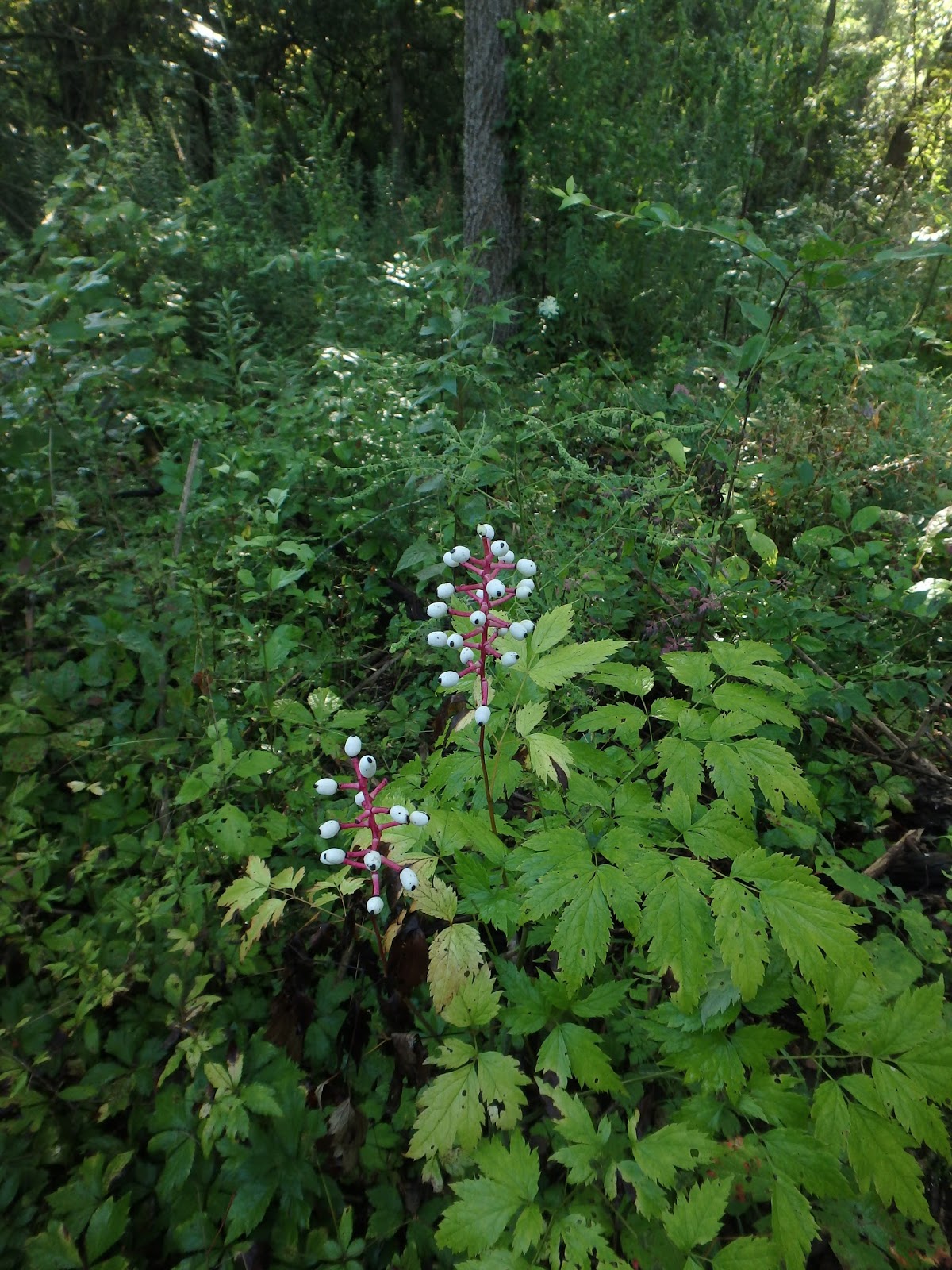
Doll's Eyes ( White Baneberry)  The fruit is far showier than the delicate flowers.

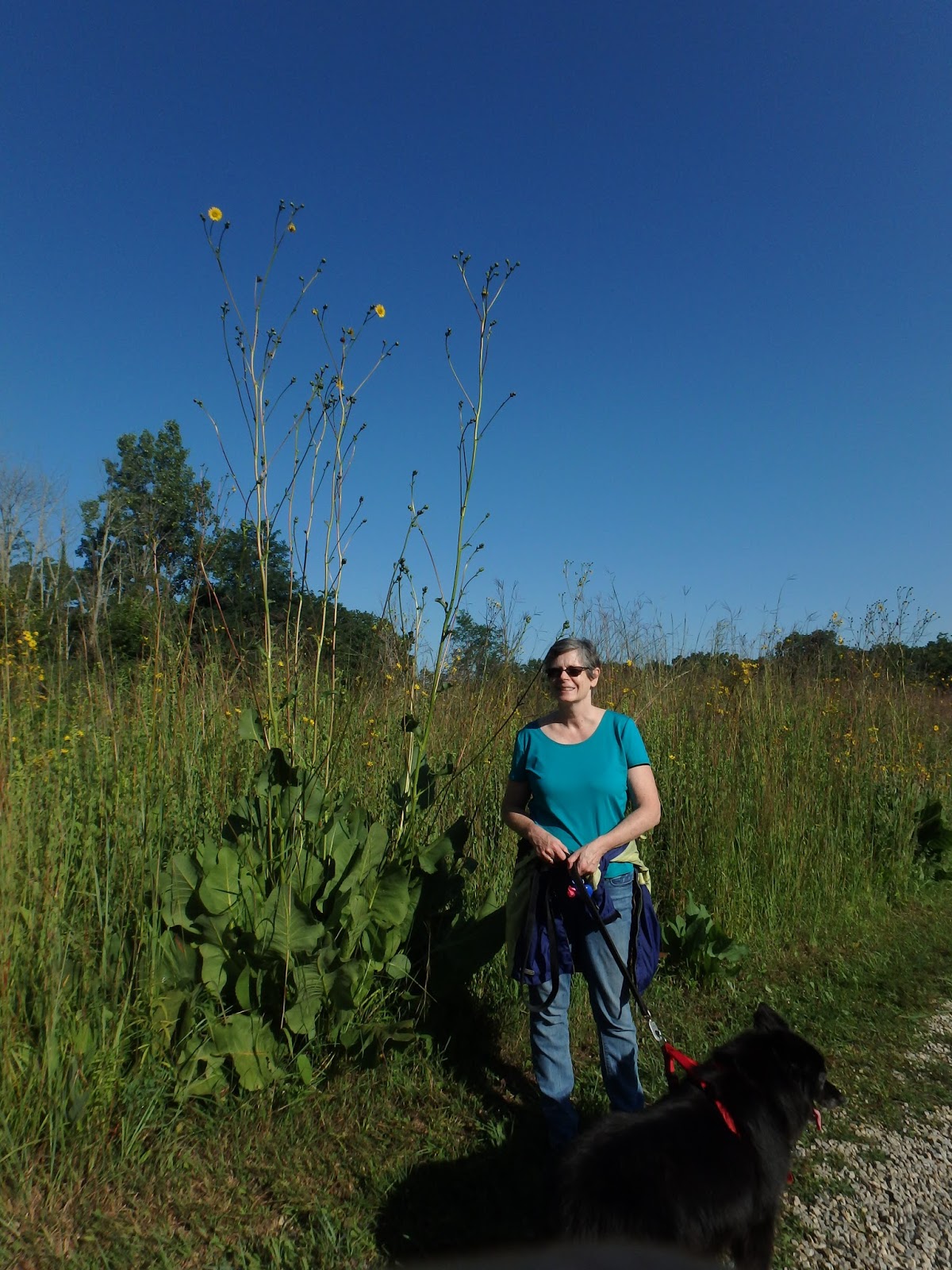
And an enormous Prairie Dock