Friday, November 22, 2013

Harris Crab House at Kent Narrows, Maryland


"Kent Narrows", I said.  "I remember that sign from the last time."  We had just driven over the bridge in the photo.  Tom was searching for a seafood restaurant where he had eaten a crab cake he had never forgotten because it was perfect.

A  moment later, he saw the hotel that he remembered from staying there the year of the marvelous crab cake.

It didn't take him long to find the restaurant.


Outside, to the right of where we parked, discarded shells were being sent up a conveyor belt and into a dump truck.


The yellow bins are full of  oysters waiting to be processed.  I assumed these were oysters.  Being from the midwest, I could be mistaken.  I wish I had asked but I didn't want to interrupt someone in the midst of his work.  Next time!


Here is the boat the oysters were brought in on.  They were in the red buckets .


Insert November 26...Beyond the boat was an interesting sign that told me more about oysters.  It was enlightening to read of the ways oysters are a vital part of our world and particularly, vital to Chesapeake Bay.


I noticed another sign yesterday at the grocery store when I bought  the oysters I'll put in the stuffing for Thanksgiving.


Two views from the restaurant windows.


And here is the crab cake.  Tom said it tasted as good as he remembered.


Tuesday, November 19, 2013

Cincinnati Scenic Railway at the Krohn Conservancy


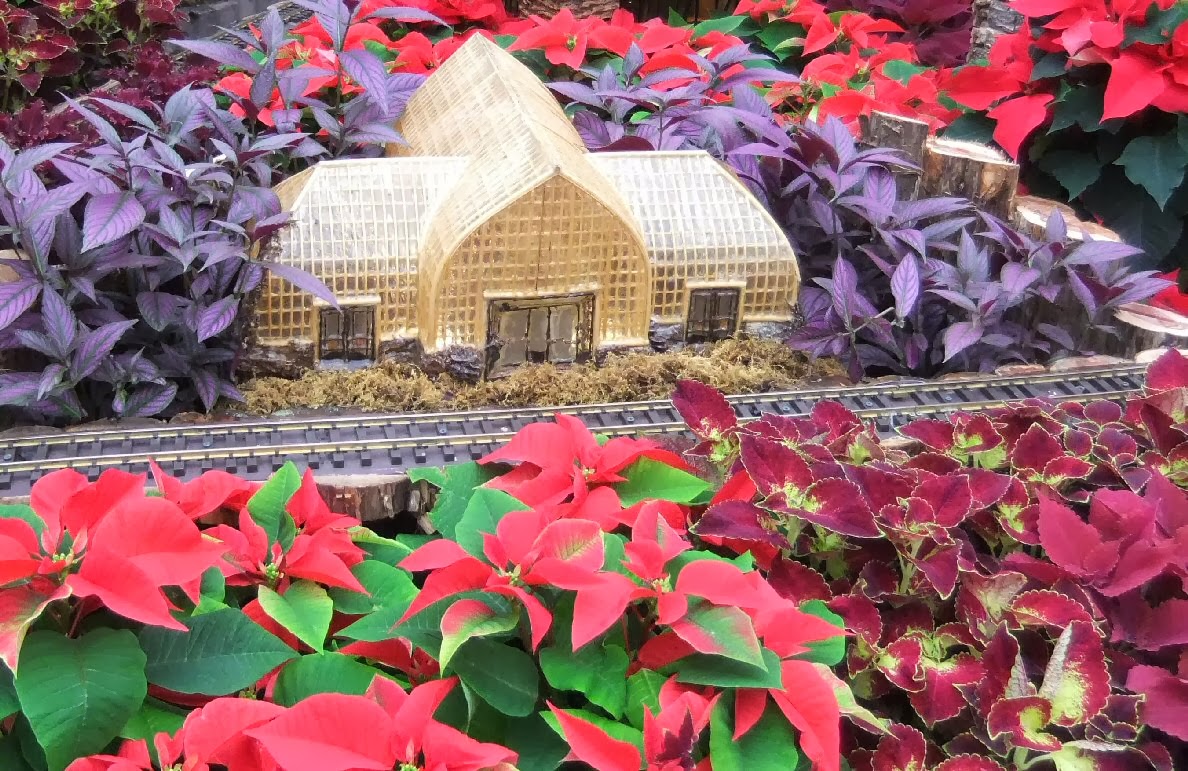
Tom, Stephen, Ray, and I went to the conservatory's Christmas exhibit this past weekend.  Here are a few photos from the exhibit.  The model above is of the conservatory which is about eighty years old.

Below is about half of the model of the Roebling Bridge that spans the exhibit.  The bridge was opened to traffic between Cincinnati, Ohio and Covington, Kentucky in 1867.  It was declared a National Historical Landmark in 1975.


Beyond the bridge to the left, two bluish towers are part of the model of the Proctor and Gamble General Offices.  The curved bridge visible beneath the engine on the bridge and beyond the closest visitors  is known by Cincy residents as the Big Mac because the actual bridge is painted bright yellow so it looks like McDonald's Golden Arches.

This Big Mac is not painted gold.   Instead the entire exhibit is constructed from natural materials.


You can see the construction materials in this railroad crossing sign.


It is fairly easy to see the natural materials on this hand shaped control for the Thomas the Tank Engine section.


The steamboat is part of another interactive exhibit.   The smokestacks puff out smoke when activated by the handshaped control.


A volunteer told us that every year something is added to the exhibit.  This year the Great American Insurance Company building was added.


Other buildings in the exhibit include the childhood home of William Howard Taft, the twenty-seventh president of the United States (left front) and the Union Terminal (upper right).


Thursday, November 14, 2013

Winter Stopped In...But...

Pictures from Tuesday morning.


A winter chore in process.  I had already started scraping when I remembered to take this photo.

The temperatures stayed in the 20s Fahrenheit (-6.6 Celsius) all day.

Wednesday was a little warmer.


But this morning, Thursday, the weatherman has forecast mid 40s Fahrenheit (4.4 Celsius)
And we are already seeing that warm sunshine.  


And most pleasant of all ...no snow or ice to scrape off the van.


Can't wait till we hit the 40s this afternoon.  Winter hasn't dug in yet.

Saturday, November 9, 2013

The Annual Carolina Renaissance Festival


While we were in North Carolina we took the grandchildren (and their parents) to the Renaissance Festival which is a little over an hour north of Charlotte.

These festivals are entertainment for people whether they like live shows, music, food, games, shopping, history taken lightly, or people watching.


We were greeted by Renaissance songs at the entrance.

Sometimes it is difficult to tell the visitors from the enactors.


We had no trouble recognizing the queen and her court.


There were some strange sights.


This is one of the eleven stages scattered throughout the grounds, all of which offered multiple shows.


For those who wanted to participate, there were carnival-like games.


Or if you wanted to be more active, you could go up...


and down...


on the Pirates Assault Catapult.

One of the shops...


Afterward you could walk around showing everyone your new finery.


There were educational exhibits like this one where you could learn more about the artisans of the era.  The man closest to the front made his  mail, link by link.


Here is a group of volunteers who educate those interested about the sighthounds popular in the Renaissance era.  You can learn more about the group at

www.HoundsofEastFairhaven.org


There are acts set up in the open areas as well as on the stages.  This is one I liked.


He didn't have business cards, told us to go on-line and type in Cale, juggler from Minnesota.  Sure enough that brings up websites where you can learn more about him.

After a pleasant afternoon, we headed south toward Charlotte.

Wednesday, November 6, 2013

Lilian Nichols, A Stylized Butterfly in Polymer Clay


Sally's butterfly.  

I didn't get a photo of the Skinner Blend Sally started with but I do have photos of Mary Ann's and mine.


From this to this...


Mary Ann's butterfly.

From this to this...

 Pauline's butterfly.

Making these butterflies took the entire four hour session.  We had time to cut one set of wings from the half circle or triangular cane we made and to add the body to complete the butterfly but not time to bake them.

I have tried to reconstruct the steps for you.

Make the Skinner blend.  We blended strips rather than triangles as is done in a traditional Skinner Blend.


How to fold the Skinner Blend...


Roll the Skinner Blend.


Compress the Skinner Blend.


Shape the Skinner Blend.


Top view.


Wrap the Skinner Blend with black.


Gradually stretch the wedge lengthwise.  Cut the resulting 6 inch wedge into three 2 inch sections.  Lay 2 inch wedges side by side.  A bull's eye cane can be inserted between two of the wedges as shown below.


Add a design of bull's eye canes wrapped in black along the outer edge of the wedge shaped cane.  More bull's eyes still must be added to the outside edge of the example below.


I don't have an example of the large completed cane but here is a size comparison so you can see how much I compressed the completed cane.  Cut the resulting cane into two sections, one approximately two-thirds longer than the other.  The shorter section will be stretched further and become the bottom wing.


Slice off two sections from the two-part wing.  Lay them facing one another. Roll a bit of clay for the body between the two wings.  Press together.  Further shape wings if you wish.